 A Nation Must Think Before it Acts
In Conversation with Eusebiu Slavitescu | Romania and Regional Security
A Nation Must Think Before it Acts
In Conversation with Eusebiu Slavitescu | Romania and Regional Security

A nation must think before it acts.
In Conversation with Eusebiu Slavitescu | Romania and Regional Security

The following conversation was recorded on September 24, 2025, and has been edited for clarity. You can listen to the full conversation here.
Natalia Kopytnik: I would like to welcome our guest today, Eusebiu Slavitescu. Eusebiu is a transatlantic relations and European defense analyst who has held various positions at the Romanian Ministry of Foreign Affairs. Eusebiu, thanks so much for joining us today on The Ties That Bind.
Eusebiu Slavitescu: Thank you for having me. It’s a pleasure.
NK: So obviously everyone’s attention these days is focused on the skies above Europe. It would be hard to start our conversation about NATO without addressing the recent airspace violations on NATO’s eastern flank. Notably, if you’re based in Warsaw, then you experienced firsthand the reaction of the Polish government to the incursions in Poland earlier in September. But, of course, a Russian drone also violated Romanian airspace earlier this month as well.
Now, Poland invoked Article 4. Romania did not. And it also, to my knowledge, chose not to shoot down that drone. What can you tell us about the sentiment in Romania about all of these events?
What has been the government’s response? And do you get a sense that Romanians are confident in their own military and NATO forces to defend against the Russian threat?
ES: So as a reaction, if I were to look at the public discourse in Romania, I think we’ve treated this with calm resilience. Also, it has been three years or so since the war started. So we are living in this new reality with a brutal criminal and illegal war at our borders. With time, you become more resilient to this.
Also, in terms of security and defense, when Romania chose to join [NATO] and was accepted in 2004 that put Article 5 behind the country. And Romanians are very trustful of this military alliance, which is the most successful military alliance. Right now, it’s very challenging with everything that happened with the Russian aggression and a lot of the rhetoric coming from the White House, which sometimes hasn’t been what the Allies would expect.
[In terms of] how we reacted to the drones? If you ask the people from Transylvania or the South, probably for them it’s not as real. If you ask the people from my hometown, for example—I’m from a very small village on the Black Sea, which is actually very close to the Mihail Kogalinceanu military base where we have an American presence. It’s currently undergoing reconstruction, about 2 billion euros [worth]. It’s probably going to be one of the biggest American bases in Europe after Ramstein.
So if you ask people from my village, for example, who can hear Iranian drones or the F-16 following them, they might have an answer that is a lot more fearful, respectively, because it is a war.
And we have the Danube Delta separating the Ukrainian territory and the Romanian territory, and often our citizens can see the bombing from the other side of the shores. So, we have videos of Romanians filming explosions, huge explosions, missiles falling, Iranian drones, and so on.
For those people, the war is real. It’s really real. So, if I would have to look at how the Polish population really looks at this [compared to] how the Romanian population [does], I would say we are a lot more relaxed.
It’s also through the historical tragedies that Poland has been subjected to, whether we talk about the criminal communist regime, the Soviet Union, or right now with the war, that the Polish people are a lot more resilient. And here in Poland, for example, everybody hates Russia. It’s true but it’s not a free hate. I work with a lot of Polish colleagues in my office, and I talk to them, and they are scared. But it’s not a fear that immobilizes you and you freeze. It’s a fear that reinforces your resilience and gets you ready.
If we talk about NATO member states, there is no country as ready, as prepared as Poland, because they have learned through history the hard way that they can only count on themselves and maybe some Allies.
So in Romania, we are really hopeful for Article 5. And Romanians really trust this NATO military alliance more than our army.
Although even our army in the past few years has bought a lot of equipment, we have invested massively.
And we are already announcing 3.5 percent in the next five years going towards the 5 percent. So in this regard, we are resilient.
But we are counting a lot on our allies. And the fact that we have an American presence in Romania, we have a French presence, Dutch presence, German presence, this is something that really reinforces our security and also the entire eastern flank, for that matter.
NK: So, you mentioned some things about defense spending and bolstering Romanian defense capacity.
We’ll return to that. Something you said about the regional differences in Romania kind of brings me to my next question, which is something that I also often find that is missing, especially on the American side when talking about transatlantic relations, where they’re going, NATO as a whole.
I think what’s often missing is a discussion or at least a reference to the internal political landscape of different member states and how that is informing their foreign and security calculations and influencing their standing on the world stage.
Now, I know Europeans probably pay a lot closer attention to what’s going on in America. Obviously, President Trump is very good at keeping himself in the headlines. But I was hoping we could kind of get the opposite, the flip-side view: Could you tell our audience a little bit about what’s been happening in Romania on the domestic front, because in the last two years, there’s been somewhat of an unprecedented series of events.
ES: A lot, yeah.
NK: I’m referencing mostly the presidential election of last year, which was annulled by the Supreme Court after the intelligence agency of Romania found that Russia was blatantly interfering in that election. The results were annulled, and the process restarted. Can you tell us a little bit more about that foreign influence campaign in Romania, and how Romanian institutions have kind of coped with that?
Have they coped well? What’s the public sentiment? And then, I guess it’s hard to talk about this without talking about Moldova and the elections that just happened yesterday, we are recording on September 29th. The pro-European party seems to have won the majority in that election. But that election was heavily targeted by Russian influence campaigns.
ES: It was, absolutely. So, on the cancellation of the election, this was quite a painful experience for us. Cancelling an election, the act, voting, is the most essential act of a democracy. Romania is still a fragile democracy, unlike our friends from the West.
Cancelling an election is a bit like chemo, right? It hurts, it’s bad, you’d rather not do it. But if you’re not doing it, well, you’re dying. So, I would say cancelling, that decision of the Supreme Court which I fully endorse, it was bad for our democracy, it was bad for the social contract, but it was much needed.
How that decision happened was: We had this candidate who wasn’t a Russian sympathizer, he was a fully Russian-aligned guy, saying to take Romania out of NATO, buying and chewing all of the Kremlin’s narratives, like getting Romania out of the European Union, barring all the multinational organizations from Romanians.
So you had this guy who in all the polls would gain two, three, four percent because we know the guy. He’s been around for a while now. And then all of a sudden, after a few days he’s number one. Obviously, we had our Allies and friends who shared intelligence with us.
Later on, we found out—TikTok actually admitted it—about 30,000 TikTok accounts. This was exclusively and mostly on TikTok. And TikTok is a Chinese application. They have the power to manipulate algorithms, as you very well know. And China and Russia, they work together hand in hand. And whenever they need it they can push the right algorithm to bring back, to make someone or to share some form of narratives.
This is exactly what happened. And Romania is not the only case. We are actually in a full informational hybrid war—call it what you want—with Russia. We have been since before 2014. Except, you see, none of our governments and leaders actually accepted it. They denied it. Because if you accept you’re in you’re in wartime, you have to do something about it, and nobody wants to do something about it.
Up until very recently, European elites, French, German—except Poland, the Nordics, Romania, because we had this experience and we know the Russian bear very well—but a lot of the Western elites would rather continue doing business with Russia. Even at the beginning of the war, even in the first year, the second year. It’s just now that you’re hearing the kind of language that the Baltics, the Poles have had in the past 30 years from Emmanuel Macron, from Friedrich Mertz. Finally, they are waking up.
So, Romania also was part of this informational war. Obviously, the stakes for Romania are enormous. Romania, Turkey, Bulgaria, we are the guardians of the Black Sea Gate, while the Polish and the Nordic states protect the Northern Gate. So, Romania was important. So imagine, we were so close to giving Romania to a fully-aligned Russian guy because of TikTok.
Also, there were many irregularities. For example, he declared zero spending. Absolutely zero. And later on the police investigation, they found millions of millions of dollars hidden at his friend’s. He was friends with some mercenaries in Africa from Romania. Anyway, now the proof is coming in more and more. For me, it’s undeniable that Russia played a huge role, but it wasn’t just Russia, although it was a huge factor.
Also, it showed the weakness of our society. If you can change the minds of 2 million people in a few days on TikTok, then that’s not a resilient society.
NK: Right.
ES: And you’re wondering about our institutions and everything. To be honest, the head of our external secret service was on holiday in Asia, while Romania was the subject of the biggest hybrid informational attack ever.
Not because [the secret service] didn’t want to look at it, but this is so highly complex, so highly complicated that nobody saw it coming. Nobody saw it coming. They could have seen it. They could have done a better job, if you ask me. Anyway, say they woke up the next day, after the elections, asking “Who’s this guy?”
And if this guy becomes president it would be crazy. But this is not the point. The point is that there are many criminal offenses [committed]. Actually, right now he’s being prosecuted. He’s probably going to end up in jail for a very long time because now we have established connections between him and the Russian embassy, him and his friends, etc. He wanted to do a coup d’etat if he wasn’t going to be president. We have the records: Some of them are public right now. So, this was very serious. Thankfully the Supreme Court annulled the elections because they were not fair because Mr. Calin Georgescu had an unfair advantage. This was his name. As I said, he’s probably ending up in jail for a long time. He’s an alleged traitor. There are many offenses that they are pursuing right now.
We know that those 27,000 TikTok accounts that pushed those narratives had their IPs in Turkey. One of our parliamentary commissions already asked our Turkish authorities to give us more information on that. As time goes on, we will have more and more information. But it’s now an established fact that Russia was one of the factors and that those elections were not transparent nor free in regards to Mr. Calin Georgescu.
This is why we did what we did, and I think it was the best thing that happened. We were very sad to see a lot of people from the US—like, for example, Elon Musk, Trump Jr. and a lot of the influencers with millions of followers on X—converge their messages with the messages of the Kremlin. It was really sad for us to see it, and that wasn’t helpful.
Anyway, I’m never really proud of my country, to be honest, but this is one moment that I was proud of. Again, it was painful. It’s never a good idea to cancel elections. It was harmful to the social contract. The public trust in the institutions right now is not very high, as is normal.
So, we need to work on that to build back that credibility.
And on Moldova, I actually gave an interview this morning to the Polish press. Let’s just say Romanians had a very good evening last night.
Because Moldova is not just a small country neighboring Romania. These are our brothers and our sisters. Over the past ten years, Moldova has made tremendous progress towards European integration.
Right now, European integration is installed within Moldova’s constitution. It’s a national objective. And well, in Romania—Russia threw a lot of money at us—but we have the European Union backing us, we have NATO backing us. In Moldova, on the other hand, Russia had no limits. We now have reports, unconfirmed reports, but probably true, where Russia has spent around 300 million euros, which is a [good percentage] of GDP of the entire country in Moldova, to try to get these elections.
And it would make sense if you put on the shoes of the criminal Vladimir Putin, because Moldova having pro-Russian forces was aligned with the Kremlin’s agenda. That would mean you can transform Moldova into a military base. You can launch missiles towards Odessa, and they want Odessa badly. They haven’t been able to conquer it, and probably they will never get it.
So this not only would be a direct security threat towards Romania and the entire eastern flank. Just like any other frozen conflict—Transnistria, for example, or Georgia—what Russia does, they create these frozen conflicts, and they keep them poor and corrupted. And whenever they need to destabilize the entire region, they push those paddles. This is basically the Russian textbook manual. We’ve seen it in Georgia in Ossetia. We’ve seen it in 2014.
We’ve seen it and we are going to [keep seeing] it if we don’t stop Russia. Because Russia only understands the language of firmness.
They do not respond to deep worries or “We condemn this and that.”We’ve seen too many times at NATO summits or at the end or EU councils. I think pretty much everybody realizes that right now, Poland realized it first. They tested Poland and Poland responded, and now more and more countries are getting more firm in standing up to Russia.
But coming back to Moldova—I’m genuinely an optimistic person—seeing how much money and effort they are putting into the buyout, in the interference, in all of these scenes that we’ve known all too well, I was afraid that Moldova might derail.
And well, Moldovans showed us a beautiful lesson last night. They understood the stakes. And trust me, if Russia wouldn’t have interfered, the score would have been much higher. But this was very good news. Moldova is coming home, a European home, where actually they always belonged.
They already tried with many pro-Russian governments, and we have seen what we see everywhere where pro-Russian forces are. Massive corruption, violence, poverty, sometimes extreme poverty. This is what Russia brings to the table.
Let me remind you, before 2022, Moldova was fully dependent on Russian gas and oil, energy, so on and so forth. Right now, Moldova is fully independent. Also, it was lucky enough to have Romania to help with this because we have the capacity of delivering energy and all of that. So if Moldova did it, everybody can do it.
And I’m really impressed, honestly, by our brothers and sisters. They really understood the stakes. The presence, the voting yesterday was a record in any shape and form. So, this is very good news. It means Moldova stays the course, and the course is the Euro-Atlantic community.
NK: Yeah, definitely. And I think, like you said, Moldova doesn’t have the backing of NATO, is not in the EU currently, and it therefore has a lot more vulnerabilities that can be exploited by these influence campaigns.
So it is heartening to see that, like you said, Moldova can stand up against all these odds and stay the course. I think that gives us some hope about the resilience of current NATO members, because these influence campaigns do not stay within borders, right?
ES: Also, it’s very good news for the European Union because it shows the EU is still very attractive. Because ultimately, yesterday, the vote was about that. Where do we head from here? And the choice was loud and clear. We want the Western world. We want the European Union.
And just like the European Union has fully transformed Poland—maybe you visited Poland many years ago, and each time you came, you probably saw a different Warsaw. The same way it has transformed and it still does so in Romania, the same way Moldova will be fully transformed.
NK: Definitely. Well, I wanted to go back to something you said about how Western Europeans or the West in general is kind of maybe waking up to a, or adopting a wartime mentality, as you said.
You said something at the Economic Forum—or you perhaps have said it elsewhere, but that’s where I heard it—and you were speaking quite passionately about European defense on this panel, about defense cooperation. You were referencing the Alaska summit, which was the bilateral summit between President Trump and President Putin. No European representation at the table, no frontline state representation at the table.
And I think you said something along the lines of, “We need to do better.” I don’t ever want to see this again.” Paraphrasing here, but essentially I think that your frustration, the point that you were trying to make was that Europeans and frontline states particularly really need to fight much harder to have a seat at the table and to be present when decisions about their own security are being made.
So I wanted to ask you, I mean, how do you assess Romania’s current situation in the context of NATO in terms of influence and leadership? Have you seen it change or evolve over the last few years? And perhaps what are the main challenges and opportunities for Romania to be more visible as an actor in the organization?
ES: In the past few years, we’ve made some progress. We are a lot more visible right now within the NATO Alliance. And we are also, to some extent, some form of a security provider in the region as a regional actor in the Black Sea.
For example, we now have a Black Sea strategy in the Congress. We also have a Black Sea strategy at the European level, and this has been pushed as much as possible by Romania.
So we understand the geopolitics, and we want to sit at the table. At the same time, compared to others, we’re a small country with limited resources. And we’ve made tremendous progress with our military, with the involvement, we have our strategic partnership with the United States. We are hosting the defense missile shield at the base Deveselu that has been there for some years now.
We are also increasing our naval presence in the Black Sea, and the Black Sea right now, it’s very important. Actually, it has become important for everybody. And up until two, three years ago, the Black Sea was basically run by the Russians. That stopped when the Ukrainian drones took them underwater.
Right now the Black Sea belongs to everybody, as it should, but we could do more about this. This new military base, Mihail Kogălniceanu, it’s good news. Romania is heavily investing in that alongside our partners from the United States. Also, the Black Sea in Romania geographically is of utmost importance for the United States in regards to the Middle East, in regards to the entire region. So we have seen, even with the Trump administration, that generally wants to step back from the European security architecture.
It’s the official Pentagon’s defense strategy. And that’s okay. We understand. The United States can decide where their interests are. What I do not understand, however, is why the European Union or the European nations have neglected our security for so long. Why?
There’s absolutely no explanation except that we were sleepwalking. We were thinking, or our leaders were thinking, that the United States will always be there. But the United States invests a lot of money, and ultimately, here, Donald Trump is right. This is your money from your pocket, your taxes. So why should the United States guard or keep our security indefinitely?
That was never going to happen. Actually, anybody just a little bit smart would see it coming. At some point, yes, Asia, China, these are growing challenges for the United States, and the attention is shifting.
But we found ourselves with the Russian aggression, with the White House administration who said, “Guys, I want you to do more,” and here Donald Trump is right, we need to spend a lot more.
If you, for example, look at the European map, from the West to the East, you will see military budgets increasing because the closer you are to the Russian bear, the more you are afraid. So the more you are spending. It cannot be just Poland or the Nordics or the United States. Finally, we see a lot of the countries now accepting this new reality that we need to do a lot more.
Alaska was a wake-up call for us. They talked about European security without Europe at the table. This is why in the next couple of days, you saw those European leaders at the White House. They got really scared. I’m pretty sure in every capital and in the EU, people are like, “Wow, what’s going on?” But this is the result, a consequence of our own actions.
We need to invest heavily in our military. You do not have public services, good hospitals, healthcare, so on, or anything without security. We need to understand that.
And now we see it. But we needed a brutal criminal war of aggression at our doors to finally understand that. Apparently, this is how humans work. You need a tragedy. You need a wake-up call to finally wake up. But right now, we have to say it, we are moving.
You only have Germany announcing 1.5 trillion investment in the military in the next ten years.
That’s very good news. You have France who keeps getting the budget up, and then Poland, Romania, and pretty much everybody, as per the agreement of the 5 percent military spending, which is very good news. I’m really grateful to the White House administration for this, but it should have happened so many years ago.
NK: Well, you brought up a lot of great points about Romania’s evolving defense strategy. I wanted to talk about Romania’s role and NATO’s defense structure a little bit more. Of course, Romania holds a critical position, as you mentioned, the Black Sea is a strategic hub, but also a critical position on NATO’s eastern flank.
It borders both Ukraine and Moldova, as we’ve discussed, both countries that have firsthand experienced Russia’s military threat. Obviously, those conflicts are in different stages.
And as a frontline state, Romania is hosting important NATO military infrastructure and has been a steadfast supporter of Ukraine during this war, serving obviously as a logistics hub, a military training hub for the Ukrainian military. And as you mentioned, it’s obviously a key player in securing the Black Sea. You mentioned a main development, this expansion of the Kogălniceanu.
ES: It’s not the only one. I could also say, for example, Romania right now is hosting an F-16 training center that is training pilots from Ukraine.
Romania also accepted Ukrainian grains to go through our ports in Constanța. We’re talking about 14 millions of cereals are already gone and that will have a huge impact on the food supply worldwide. Romania has been part of that.
Also, Romania is hosting right now—we used to have a lot more, but they left—around 200,000 Ukrainians with social benefits and everything. This is very good. These are our friends in time of need. So, logistically, Romania has done a lot.
Romania is among a very selective club of countries that have donated a part of or the fully functional Patriot system, which is valued at around 1 billion euros.Thankfully the United States gave us another one as a donation. So, it was a win-win situation.
But Romania has done all of those things. And we continue to support Ukraine with everything that we can. Again, we have helped Ukraine with Soviet-type ammunition. Romania, for some reason, chose not to publicize the list of the help. But now we know, I think the prime minister a couple of weeks ago said that it’s mostly ammunition from the Soviet era. Ukraine is still using a lot of Soviet-type armament equipment.
So a lot of those have been transferred to Ukraine: the Patriot system, logistics, and maybe human intelligence, stuff like that, which is very good.
We have to support Ukraine. Ukraine’s security is Romania’s security, just as it is the entire eastern flank’s security. If Ukraine falls, Moldova is next. And that would be catastrophic, not just for Romania, but NATO, the region, and the entire Alliance.
NK: I wanted to kind of pivot here. This project, The Ties That Bind, started last year, and it was meant to be kind of as a reflection on the Alliance, its role in transatlantic relations over the last seven plus decades.
So, to close out the conversation, I want to go back to the beginning. Romania joined NATO in 2004. As with most former Warsaw Pact countries, the 1990s, the early 2000s were times of great transition. Certainly, they were not all seamless transitions and were not all painless, and certainly for Romania, the end of the 20th century was quite violent and tumultuous, with the 1989 December revolution, the fall of the Ceaușescu regime, all of the aftermath of that.
I’m curious to hear from you, and not to force you to reveal your age here, but how do you assess Romania’s 21 years in NATO now? What did that NATO track mean then, and has it changed now?
ES: So 2004 for us, after the tragic communist regime—because it was tragic and criminal. I will repeat this because a lot of the people still are very confused about this.
NK: I think it’s important to re-emphasize.
ES: After the fall of the criminal communist regime, the transition was really harsh for us. As you mentioned, the revolution, the killings, then we had some other events that were quite unfortunate. That took Romania into a very bad spot, where the Soviet Union wasn’t there anymore. We couldn’t sell anything on the previous market that was created within the Soviet Union. We weren’t in the European Union. We were in between nothing. The prospects were really bad. Romania was going through a really bad time.
So, this is the moment when the entire political class in Romania gathered at a place called Snagov, and they all decided that the vision and the dream for Romania is full integration within the Euro-Atlantic community.
That started with NATO, with Bill Clinton who was the first one to push for us, also with Tony Blair, those famous visits in Bucharest.
So that was something that was a consensus in the society that tried the eastern experience. It was horrible. Now let’s go back to where we actually belong through our Latin roots and religions and all of that.
So it was probably the proudest moment for our political class: At that moment everybody agreed, even Ion Iliescu, the former Romanian president right after the communists, who was a communist.He actually died a communist. But even he saw that there’s no other way. So everybody agreed on that.
And the 2004 moment was a big deal for Romanians. It was not just about security first: Prior to joining NATO, you need to go through reforms within the military, change of command and stuff.
So, that first really helped Romania itself, but it was so much more than security. During communism, if you were to speak with absolutely any elderly in the country, there was this saying, “We are waiting for the Americans. The Americans will come and they will save us.”
So for us, after the revolution happened, these 2004 moments brought back all those feelings, and they were pretty much shared across the board within Romanian society. Finally, the Americans came.
So this was not just about security, but coming back to the family where we belong, to the family where we want to share those values, where we want to have those shared human rights, human decency, freedoms of expression, all those that you have put so well in the Constitution.
It was a dream for Romania. It was this vision. And we all fought for it, just the same way as we did with the European Union. It’s in the same format as Moldovans are doing right now. And they are saying “We want to be with Europe.”
Because Europe [means] prosperity. It’s not perfect—the European Union is far from perfect. Sometimes it regulates all the things that it shouldn’t. Sometimes it makes a lot of mistakes. But overall, the European Union was about peace. We all too often forget that, but the European Union is the biggest peace project in the history of humankind. Before the European Union, every year you would have war between countries, everybody versus everybody, even before long before the First or the Second World War, the Hundred Years’ World War, so many.
This was about peace, and peace we have brought. So again, the NATO moment was the moment when we said, we’re back, we’re back where we belong, in this family of values, and the same happened with the European Union.
I was a kid back then, I was born in ‘91. But there was an exaltation in the society back then.It was hope. And in those dark times, hope really meant a lot. NATO was a first step towards that going back to that family, where we actually belong now, we are full members. And we actually always belong to that family, to be honest.
NK: Yeah, it’s funny because when I’ve been talking to guests on this podcast—my previous recording was about Poland, so that’s a little closer to my experience—but I keep thinking that the memory of joining NATO, joining the EU is still in the living memory of several generations, right? In countries such as Romania, Poland, Latvia, everyone on the eastern flank essentially.
And, in the States, I feel like it’s just a distant thing. It’s just a buzzword. It’s like, NATO this, NATO that. But I don’t think there is that same emotional or collective memory surrounding what that moment meant, right? To be a Romanian and how joining NATO, joining the European changed that. Or you said it was a return.
ES: Yeah, it was this sense of freedom that these countries had in the eastern flank, we never had that before. The freedom to buy jeans, to drink Coca-Cola. As stupid as it might sound, that was the symbol of freedom, and NATO also meant that. The European Union also meant that.
So, it goes far beyond the implication or, in our minds, far beyond, and it was celebrated in Romania big time. I was a kid, but I do remember that moment.
NK: What would you like the American public, our American audience to understand about Romania’s role in NATO in the transatlantic Alliance and why fighting for preserving these alliances like NATO is so important today?
ES: I would first start by saying thank you to the Americans for saving Europe twice. There are hundreds of thousands of lives lost in Europe and they liberated us, some countries earlier and then some others after ‘89.
So thank you for that sacrifice. That’s something that we will never forget.
We also don’t have better friends than the Americans, and to be very honest with you, I don’t think the Americans have better friends than Europeans.
I would also like the American public to understand that isolation is never the answer. If you look at the past 70 years of US history and all the prosperity, it’s because previous administrations decided that isolation is not the answer.
I think this still stands today. Even with this new rhetoric from the White House, obviously what the Americans decide is in their interest. It’s up to them to decide. We can only respect that.
It’s absolutely normal that the US wants to shift focus from Europe to Asia, to China. We fully understand that. We just ask you to not leave us behind. We were at war with you in Iraq. We were at war with you in Afghanistan.
And there were many sacrifices made. We never asked for money back. We know after it was because that Alliance was based on values and what the Americans were protecting and trying to protect in Iraq, in Afghanistan, regardless of the reasons. We share those values, and we have them here at home and want to keep them.
And honestly, as a Romanian, I really want to strengthen the relationship and the strategic partnership with the United States. I still believe this is the best way forward.
Yes, we need to do more about our security. Yes, Donald Trump is right when he says that we need to take more on our shoulders. He’s absolutely right about this. But America first cannot be American alone. I don’t think that’s the answer.
I think ultimately both sides understand that we need each other, especially in this context with an ever more aggressive China, with an ever more imperialist criminal Russia, with a global South who isn’t sure where they are positioning themselves. And to face these threats, and let’s say it honestly, what happens in Ukraine depends on what’s going to happen in Taiwan.
There are people in the White House, and also sometimes I hear experts in security defense talking and hoping for the decoupling of Russia from China. That’s never going to happen. Russia is now pretty much dependent on China. Even in this criminal war, China is giving software, a lot of money, buying all the oil, all of that. This is never going to happen.
If you want to face China, don’t do it alone. It might actually be very difficult for you to do it alone. We are your best friends. And in my view, our interests fully align on Russia. We need to stop this imperialism. If we are not stopping it, it will not stop. Russia, again, only understands the language of force and firmness.
And to be honest the United States remains the only power in the world who really has the leverage to pressure Russia, really. It’s the only country, and we know it in Europe. That’s why we’re so afraid.
NK: Well, Eusiebu, thank you so much for all of your insights, for sharing your perspective. And thank you so much for joining me today on The Ties That Bind.
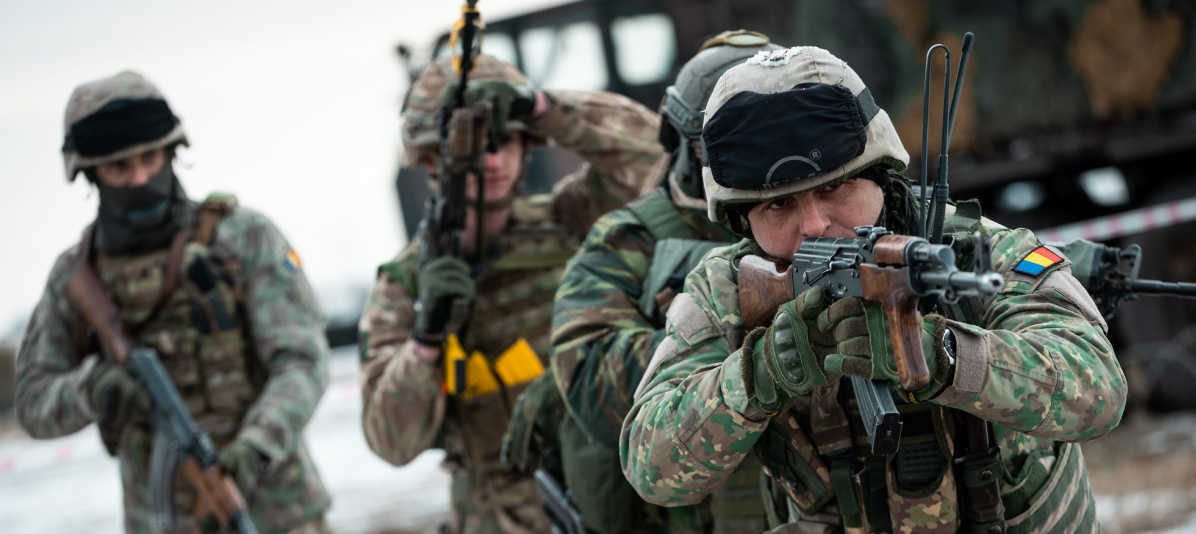
Image: Flickr | NATO