 A Nation Must Think Before it Acts
In Conversation with Minna Ålander | Finland’s History, Defense, and Path to NATO
A Nation Must Think Before it Acts
In Conversation with Minna Ålander | Finland’s History, Defense, and Path to NATO

A nation must think before it acts.
In Conversation with Minna Ålander | Finland’s History, Defense, and Path to NATO

Natalia Kopytnik: Hello, everyone. My guest today is Minna Ålander. She’s an associate fellow at Chatham House and a non-resident fellow at the Center for European Policy Analysis. Minna, thanks so much for joining us today on The Ties That Bind.
Minna Ålander: Thanks for having me.
NK: So we are talking about your home country of Finland today. In my past conversations with guests from Poland, Romania, and Latvia, we did a little bit of a reflection on their countries’ paths towards NATO membership towards the end of the episode.
But since Finland is one of the youngest member states, formally joining NATO in April 2023, in the wake of Russia’s full-scale invasion of Ukraine, I thought we’d do this in reverse order. So, one could say that in many ways, this move to join NATO was revolutionary in turning back decades of policy. But also in many ways, Finland had already been cooperating closely with its neighbors in the Baltic Sea and with NATO Allies for several decades.
Perhaps let’s go back to February 2022. What was the atmosphere like in the months that followed? And how do you view this shift of Finnish societies towards the Alliance so quickly?
MÅ: The first months of the Russian full-scale invasion of Ukraine were really intense in Finland. There was this real concern, and people were actually mentally, and to an extent also physically, preparing for the possibility that the war might expand beyond Ukraine. When you look at the map, you can see that there’s a lot of room to expand over to Finland with the very long border that we have with Russia.
So, the mood was really intense. Just as a personal anecdote, I had this conversation with all my Finnish friends, regardless of their profession and background about what each and every one of us would do in that case.
And also with Finnish friends living abroad, like myself at that time in Germany, we all were wondering whether we should go back, [thinking] like “Do we need to be able to do something” and so on, like “What are we supposed to do?” So, that’s just to give some background to just how intense the mood was, and that also reflected on the NATO process. In the Finnish case it was so interesting that it was a completely sort of public opinion driven, really bottom-up process. So, the change of opinion happened virtually overnight.
Finland had had pretty stable numbers in favor of staying outside of NATO for decades. Support for NATO membership, I don’t think that it ever really got even close to 30 percent of the respondents in any polls before February 2022. But then in the first poll published on the 28th of February, just a couple days after that full-scale invasion was led by Russia, we had a majority in support for the first time. That was a super clear red line for a lot of Finns. I think this is something that we often miss when we talk about Russia’s war of aggression, that we don’t talk enough about our own red lines.
As you also mentioned, it’s really important to remember that Finland had this long-term policy of building as close a partnership as possible while still not being a full member of NATO. It was also linked to this Finnish policy of the so-called NATO option. This was always a response to Russia’s frequent and regular threats towards Finland, and about what Russia would do if Finland were to join NATO.
This NATO option implied to Russia that if the security environment significantly changed, then Finland would reconsider this choice up until then to stay outside of the Alliance. And all the conditions were met. The security environment changed radically. It was exactly the kind of push that had always been foreseen as a possible catalyst for the Finnish NATO application. It was actually very logical in that sense.
The interesting thing was that political parties had started moving a little bit in that direction, but then the urgency of the moment really forced the political leadership to actually catch up with the public opinion. There was this sense in March 2022 that like, “Why didn’t we join NATO last week? Why is it taking so long?”—although it only took less than three months for Finland to do this complete U-turn. So, actually, it was extremely fast and agile but people had no patience whatsoever in that moment.
NK: You mentioned that the first thing that happened when you spoke to all of your friends in Finland—the discussions of “What can everyone do?”—I think that’s so reflective of the culture of Finland.
MÅ: Totally.
NK: That leads me to, naturally, the next question, which is about Finland’s collective defense or whole-of-government, whole-of-society defense approach.
You wrote a piece for New Eastern Europe this past summer for their Baltic issue, which I really enjoyed. And you outlined the model and how in Finland’s constitution, it’s really enshrined that its response to civilian responsibility is also part of the defense concept, not just the military, but the whole of the population.
These days it feels like the words resilience, collective security, collective defense, whole-of-society approach, all these kinds of buzzwords are so popular in discourse about European security these days. And I think the integration of the civilian component with military defense strategy is definitely of huge importance to NATO in this day and age.
So, what is Finland’s whole-of-society approach, and how can other NATO Allies learn from it?
MÅ: Finland has for a very long time had this comprehensive security approach. We call it comprehensive security. The Swedes call it total defense, and because Swedes are better at marketing, everybody knows total defense.
So, let’s just call it the total defense in Finland too. It’s basically the same thing. We used to look to Sweden in the Cold War, like back in the ‘60s, and copy some elements, so there are a lot of similarities between the Finnish and Swedish models. It’s just that Sweden completely dismantled their system after the Cold War, whereas Finland didn’t. So, right now we’re in a little bit of a better position compared to Sweden in the sense that we don’t have as much catching up to do.
But basically, Finnish comprehensive security or its total defense system includes exactly the elements that you were mentioning. So, there’s not only the whole-of-government approach—which means that all of the branches of government and all kinds of authorities work together, and there’s a quite clear and well exercised division of labor as well, like whose responsibility is what in a different type of crisis—but it also involves this whole-of-society approach [and] basically the reason for this is threefold.
It has to do with Finland’s geography, obviously, the fact that we have such a long border with Russia. And then the second aspect is the history, namely that Russia has basically throughout Finland’s history been the only real threat to Finland’s security. And then the third aspect is that we have quite a big country actually, in terms of territory, but a small population, only 5.5 million. In that context, if you want to actually credibly and efficiently defend all of your territory, everything counts. So, you need everybody to contribute to the national defense effort. That’s why we also have this constitutional clause which implies that all citizens are expected to contribute in some way.
For men it means military service, so we have this old school conscription system in place still where it’s voluntary for women but obligatory for men. And then for the rest who don’t have some kind of a military role, there’s a number of national defense related organizations, associations, and all kinds of things, not only more than 300 reservist organizations, but also these voluntary national defense associations that offer different possibilities for also just civilians to engage and learn skills. It made global news actually in 2022 that Finnish women signed up for these voluntary courses in record numbers, and there weren’t even enough places for everybody in these courses because everybody wanted to learn how to shoot.
That was one part of it. And there is also this idea, and it has very intimately to do with what we are seeing in Ukraine: How Russian wages war is that it very heavily targets civilian infrastructure, like energy infrastructure, whatever can be in the widest possible sense considered communications infrastructure, etc. It tries to terrorize civilians so as to reduce their morale.Therefore, there’s this heavy emphasis on making sure you have the military defense and the civil defense component. And that those work together to make sure that even under wartime conditions, civilian life and general life in society can keep going and that generally the state can keep functioning. That’s the idea behind it.
Of course, this is very deeply rooted in the Finnish expectation that we would be maybe left alone again. That happened once in the Winter War, during the Second World War, that Finland was basically left to face a Soviet invasion alone. So, there has always been this really deeply ingrained idea that we have to be able to first and foremost always defend ourselves.
We cannot rely on outside help, and that can never be plan A. It’s ideal if we can get some help, which should be the case now that we’re in NATO. But nevertheless, that’s a very core part of the Finnish defense thinking: that the first and foremost responsibility always lies on our own shoulders.
NK: So you mentioned the volunteer defense programs, the popularity of them among women.
That’s really interesting because I think in other frontline states, the conversations I’ve had there are beginning to be that realization, that a whole-of-society approach cannot not utilize half the population, and, of course, [they’re happening] in Finland, of a comparatively small population, for example, to Poland. It’s interesting to hear how popular they’ve been, so it’s clear everyone feels the responsibility to be prepared and learn.
What other kinds of initiatives or programs are part of this concept? In the piece you mentioned the shelter network and how it’s probably the most developed in Europe. I know I was speaking to a guest in Latvia a couple of weeks ago, and they’re starting to really invest in updating their Soviet-era shelter network, building new shelters, passing new legislation. So, are there any other standout programs or initiatives as part of this whole-of-society approach?
MÅ: Before I get into that, I should maybe mention that we of course have this debate in Finland about making the conscription model gender neutral, because it is really the old school version that we have still in place because it was never discontinued.
For example, in the other Nordic countries, they have opted for this gender neutral selective model where you don’t pull all of the age cohort but [do so] in a selective way. The Finnish Defence Forces have so far been reluctant to go for it, but I think that demographic trends will make it necessary at some point to expand conscription to apply also to female citizens. This will very likely be the future. So yes, when we talk about how Finland stands out in this, which seems an almost obsessive way of going about defense—I mean, in the sense that everything is viewed through this lens of “Can this be security liability or vulnerability?” and so on.
For example, we have 4.8 million places in civil shelters for the population of 5.5 million. That means that basically everybody who’s not fighting at the front lines could get shelter.
Those shelters are used in peacetime as sort of underground sports facilities or storage space or something like that. It’s a very popular thing these days for foreign journalists to go look at the civil shelters in Helsinki. The mayor was joking that that must be the number one sightseeing attraction at the moment in Helsinki.
In Finland, it’s legally regulated that every building above a certain size has to have a civil little shelter. And the interesting thing about it is that the rules are quite strict. The walls need to be very very strong and thick and so on so that they can even withstand a nuclear fallout. And here I should mention that the Finnish system is not only geared toward war, but all kinds of other catastrophes as well. War is only the worst of the worst case scenarios. It’s not only in case of Russia nuking us, but also in case that there was a malfunction at one of the nuclear power plants or something. So, it’s broader than just preparing for war. But of course, all of this is sort of multipurpose.
At the core of the Finnish system is something called the national defense courses, which are like if the conscription or the military service were a way to sort of socialize the population into the threat environment and also to communicate about the needs of national security and so on, what it takes to defend the country.
These higher level national defense courses are a way to do the same on the elite level, so they take place on the regional and the national level, and they bring together stakeholders from all relevant areas: like national government, local administration, providers of critical infrastructure, but also other business leaders, cultural representatives, NGOs, even the church—so, everybody who is in any way relevant for the functioning of the society.
This is an almost month-long course where the participants work through various scenarios and exercises, like what would their specific role be in a certain type of crisis and how would the cooperation work with other authorities. And this is a really good system. This has been in place since the early ‘60s, and it’s really highly esteemed in Finland. It has this kind of prestige if you get to participate there. It’s a sign of your importance in society, and people are really proud of it.
You get a little pin, and people wear the pins as a sign of their importance in a way, and really it’s also a formal way of creating informal networks where people get to know each other. They keep in touch, there’s alumni networks and so on, so there’s this informal aspect to this coordination approach that people know each other, they know who to call, what to do, with whom to coordinate in a certain way when something happens. This is actually hugely beneficial for the overall coordination because quite often the problem is in many countries that everything happens in silos and it’s very hard for various authorities to figure out who even is their counterpart, even within their own countries sometimes.
This is a pretty good system that we have in place in Finland.
NK: So, you mentioned in your really great newsletter—we can link it, Northern Flank Notes.
MÅ: Thanks.
NK: I just saw that a new edition came out this morning or my morning, I guess your afternoon. But in one of the older editions, you mentioned this concept that all of your friends were seeking to contribute in some way to this renewed sense of urgency in defense, and you mentioned even artists and architects, people that have no relation to the defense or government industry.
I’m interested from your personal experiences or to your knowledge, what examples you’ve seen of people thinking about their contributions to resilience and defense from completely unrelated fields.
MÅ: Well, for example, I always find it fascinating to talk to my friends who are architects because they tell me, for example, how annoying these rules about the civil shelters are when building, because it’s very expensive to build those thick walls. And if they want to expand the buildings even a little bit, the costs sort of explode and so on.
NK: Right.
MÅ: So, there’s some very practical real-life consequences of this. But also, it was just impressive how everybody had thought about what they would do and [also what] they would be willing to do. Everybody had wondered whether they had any relevant skills, regardless of their profession.
Friends abroad wondered whether there is anything or anywhere they should donate money to or something—although that hasn’t really been an issue in Finland so far because a lot of things are very centrally organized, so we haven’t seen the same grassroots movements happening as in Ukraine, but who knows if actual war comes, whether that will be the case in Finland too. But there really was a readiness rather than, for example, looking for the furthest away overseas territory that belongs to France or something and thinking about moving there.
All my Finnish friends really wanted to be in Finland and do something about it. That was pretty impressive.
I think for my generation who was born after the Cold War, I would say that we were maybe the happiest generations of Finns because for us, Russia didn’t matter all that much because Finland just joined the EU, and everything else was open and possible. There was this better period where one didn’t have to worry about Russia all the time, and it felt sort of like Russia was just one country among others and maybe not the constant threat of occupation for everybody. So then there was this sort of realization like, “Okay, well, apparently, unfortunately, Russia still is the way it used to be.” And all of this emphasis on the memory of the Winter War in Finland and all that, it felt all of a sudden much more relevant again.
That was quite powerful as a national experience, but that’s also the tragedy for many Finns, that we have these very painful memories from our own wars against the Soviet Union 80 years ago, and it’s only been a couple generations since. My generation still had the grandparents generation who had actually fought in the war. Basically every Finn has some family member who was somehow involved in the war. So that was also pretty painful.
And that is also a reason why it was so easy to understand what’s going on in Ukraine. It was just this remarkable similarity of Russia’s attack on Ukraine and how the Soviet Union in 1939 attacked Finland. Even then Russia or the Soviet Union expected that attack to be a very easy one and the war to be over within two weeks, and [Dmitri] Shostakovich had already composed a victory march to be played in a parade in Helsinki. The similarities were just so uncanny between what happened then in Finland and what you see now in Ukraine—even with this really horrible human safari that Russians are doing in Kherson with drones, we had a similar experience, but it was at that time Russia using, for example, airplanes to really hunt individuals in the forest of Lapland, if they could spot them in the snowy forest.
It has felt really personal to a lot of Finns because it’s so similar to the stories we grew up with. So, I think that was a big part of why everybody felt so seriously worried, but why there was also this productivity to it that people thought about, “Okay, what am I going to do about this? How do I contribute personally?” instead of just getting paralyzed.
And, I would add, that’s also the whole point of this extensive preparedness, that it empowers citizens to have the feeling that they know what they would have to do in a certain situation. They would know where to go, like where their civil shelter is. A lot of Finns have this 72-hour recommended home preparedness, and that helps to keep calm in these moments. So, there’s also that psychological effect to this. And also with the civil shelters, it’s not necessarily that people think that it’s desirable to survive a nuclear Armageddon or something.
It’s just that it has a calming effect when you know that the leadership has thought of even that very remote possibility and they have prepared for it somehow.
NK: So, the historical parallels between Finland and Ukraine are so interesting, and Finland’s history is so fascinating I think it’s worth recapping in broad strokes for listeners. It’s really a history of resilience: regaining independence in 1917 after spending most of the 19th century under the Russian Empire, and then before that, hundreds of years under Swedish rule. And then, as you mentioned, the Soviet Union attacked Finland in 1939, and the Winter War commenced. Then there’s the Continuation War in the ‘40s. Then the Soviet Union essentially forced significant land concessions, reparations. But throughout the tumultuous 20th century, Finland, unlike many other countries in its region, did manage to navigate the end of World War II and the Cold War, retaining its independence. So, obviously, we have the so-called Finlandization from the outside.
People said it was an appeasement of the Soviet Union, but, despite all these devastating losses, the reparations, the loss of territory, Finland did persevere as a nation, as a people. And really, as we now all hear, it has managed to rebuild itself after this really terrible time into a model country on many fronts, including obviously defense—what we’re talking about.
And I think there are parallels with Finland being a model for Ukraine, potentially, in terms of how the Finnish leadership thought about the future of the country, playing the long game. Recently, the Finnish president Alexander Stubb said in an interview, with The Economist I believe, that Ukraine can learn from this example or that arguably Ukraine is in a better position than Finland was in 1944 because it has allies. It does have support from the outside, whereas Finland in 1944 had no one to turn to.
So, from your view, do you think there are parallels for Ukraine from the Finnish experience, navigating a place in the world between Russia and the West?
MÅ: I would say that Finland’s example is more a cautionary tale to Ukraine and other countries in the South Caucasus. I would say that what we are seeing right now in Georgia, for example, is essentially like a Finlandization attempt gone wrong. First of all, I would say that what Ukraine is experiencing now feels to us like their Winter War, but just much longer, unfortunately.
But what happened after the Winter War, and this is quite important, was that Finns were really shocked about the conditions of the interim peace, when Finland in the first instance had to cede territory in Karelia to the Soviet Union, partially due to the pretty optimistic war propaganda. That came as a shock to the population.
That then of course led to this revanchist spirit. Obviously Finland was at that time between a rock and a hard place with no outside support and both Nazi Germany encroaching on Finland and then the very likely possibility that the Soviet Union would invade again. That was definitely part of the reason but it also led to the Continuation War to an extent because Finland did try to take back those territories in the Continuation War, and unfortunately, as it happened, we ended up losing more.
So, I really wish that the Ukrainians are spared these painful concessions and conditions of a peace that is just untenable and unacceptable to the population and will lead to this revanchism.
Many Finns get very triggered about these suggestions that Finlandization could be an option for Ukraine—it definitely wouldn’t be, and there’s a number of reasons for this—but the most important reason was that for Finland being less important was both a blessing and a curse. It was a curse in the sense, of course, as you said, that we didn’t get much more than sympathy from the outside. But on the other hand, we were also much less important for the Soviet Union than Ukraine is to Putin today.
Finland was never anywhere close to the priority, the spot that Ukraine has on Putin’s obsession scale. So this arrangement will never, ever be an option for Russia. So even if Ukraine wanted to try this, I don’t think that it would ever be enough or acceptable to Russia.
And then there’s also, just with what I’m thinking about, for example, the Georgian example, this inherent danger.
In Finland, there was this balancing act where you had to very carefully and cautiously take into consideration Soviet interest in foreign policy, and there were numerous limitations on Finland’s room for maneuver that Finland was then trying to navigate by emphasizing that it was a neutral independent country, not a part of Soviet Union, and therefore was able to balance it to an extent with having relations and trade and so on, also with the West at the same time, as long as it was balanced.
But the issue was in the Finnish case, there were two big differences with Ukraine today. One was that Finland had at that point already consolidated as a democracy, so Finland had a pretty resilient domestic democratic system, and the Russian influence in Finland was on a much lower level because the context had also been less between Finland and Russia. Even when Finland was a part of the Russian empire, Finland had really wide autonomy. Finland never really became so much a part of the Russian world in that sense.
An ex-ambassador of Finland to Russia and Sweden once described this as Finland having been part of the Swedish world, not the Russian world, and the Russians knew it.
So, I would say that that was one important reason why it was possible to keep the balance. It had negative effects on Finland, both domestically and internationally, of course. But we managed to not let it go too far.
And I think we see in the Georgian case how it’s very hard to maintain that balance if you already have a substantial Russian influence within the country and then weak democratic institutions. So it’s much harder there.
Also in the Finnish case, Finland had the Nordic group as a framework to rely on. There was quite a lot of support from, for example, Sweden and also Norway. Generally, this just placed Finland differently in the international context. It also was a marker against the Soviet Union that Finland belonged to the Nordic group, which clearly was not part of the Russian sphere or of the Soviet sphere of influence. I mean, Ukraine simply lacks all of these things or these features that Finland had at that point in time.
And also, what is quite often misunderstood about Finlandization is that in Finland, Finlandization describes an era in history. It’s not actually a strategy. It was just that period of time. That also sort of indicates why it can’t be replicated. Of course, one would hope that the past 80 years mean something, and everything that has happened in that time in terms of figuring out rules for relations between states—like that borders can’t be changed by force and so on— that’s, of course, the main reason. That has nothing to do even with Ukraine or Finland or any other countries. That should be reason enough why this shouldn’t be an option anymore these days.
NK: Unfortunately, it seems history does repeat itself.
Switching gears slightly, I just wanted to briefly touch upon something that I think Finland and many other countries on the Baltic Sea have a lot of experience with, which is Russia’s hybrid warfare tactics.
You contributed to a report for the Stockholm Free World Forum, on tracking Russian hybrid warfare. I thought your section covered an area of hybrid warfare that maybe doesn’t get much attention because we hear about, of course, undersea cables, we hear about drone incursions, but we don’t hear about strategic purchases of real estate.
Perhaps could you just tell us a little bit about that?
MÅ: Yeah, I think that was such an interesting case to present to people outside of Finland because it’s, as you say, not well known. And it shows how long-term this whole issue is.
It’s not that Russia just started doing this as a response to our support to Ukraine, this has been ongoing for a way longer time. So, what happened in Finland was that in the early 2000s, after the EU accession, Finland sort of relaxed the laws on third country nationals, meaning nationals of countries outside of the EU and the European Economic Area, and their rights to buy property in Finland. And then what we saw was a pattern of Russian nationals starting to buy properties, very often allegedly for some holiday or business purposes, in interesting locations: very close to military bases and or other strategic areas, or sometimes just next to a data center or cell tower that is relevant for a lot of communications, and conveniently close so that you may be able to listen a little bit of what’s going on.
Also some just interesting design options, like building high towers in alleged holiday homes with a nice view over some kind of an airfield or whatever.
So, there was definitely a weird sort of feel to this. By the way, this is not only in Finland. There’s a number of cases also in Sweden and Norway. For example, in northern Norway there’s some holiday cottages that are on a hill that overlook a military airfield known as the Russian cottages because they are owned by oligarchs close to the Kremlin.
The Russian Orthodox Church is also in on this, so it’s a very dual-use church. There’s a couple of churches that have very interesting locations: For example, one is right next to the most important and biggest naval base in Norway. And the other, in the other interesting case in Sweden, is one next to an airport, only a five-minute walk from an airport that is quite important also for national defense purposes. There’s a lot of these interesting choices of locations for either churches or holiday villages that Russians have chosen.
But in Finland, this pattern started emerging. And the interesting thing was that it was observed and it was even debated in the Finnish parliament already around 2014 because then there was this concern that Russia was maybe planning to use these properties as a sort of launch pad in a way for a little green men operation. There were particular concerns about one company that had bought a lot of island and coastal properties in the Finnish archipelago. It started really looking like they could really establish some kind of an operation from those properties, especially because there were also suspicious elements built there, like a helicopter landing platform on one of the islands and so on. Now what has happened in Finland is that the laws were changed again so that for the past couple years now, third country nationals have had to apply for a permit from the Ministry of Defense if they wanted to buy properties in Finland.
Quite a number of permits have been denied. And now, this year, the government actually even went further and effectively banned Russians entirely from buying properties in Finland. And how they did this was that they wrote a law where a country that is waging a war of aggression and constitutes a security threat to Finland, nationals from such a country cannot buy property. So that means then both Russia and Belarusians basically.
Now times are very different and the government is currently actually also looking into confiscation of properties if they are deemed to potentially constitute a security threat.
This is actually a real issue in Finland that is taking [up] a lot of government attention even. Finland is a frontrunner here among the other countries where there are known cases where these suspicious purchases have happened, [but they] haven’t so far tackled it in any way. So, it is pretty interesting that Finland has gone very far also in terms of the legal measures here.
NK: And you mentioned this was already happening over a decade ago, which I think just goes to show the long-term approach.
MÅ: Yeah, like it started twenty years ago, basically.
NK: Well, to wrap up here, I want to start back at the beginning. Something that I’ve been asking everyone in the series this season [involves] two things. One is: What lessons do you think other NATO members can learn from Finland’s approach to endurance and resilience towards Russia specifically? And the second question is what would you like Americans to know about why it is so important to continue supporting alliances like NATO?
MÅ: Finland has a pretty unique system in the sense that there is this remarkable consistency in [maintaining] the system, in [its] threat analyses, and also taking the right measures. So, in Finland, there is this realization that as a small nation like us, we need to at any time be able to demonstrate real national defense capability.
That’s why Finland has kept up this conscription system, for example, which means that Finland, although a small population, only 5.5 million, nevertheless has a total reserve of almost 900,000 at the moment.
The interesting thing is that the government is looking into increasing the age limit of the reserve which would then bring some 125,000 more guys into the reserve—older ones, of course, but there’s a lot that they can also do, like logistics or, I don’t know, whoever can operate the drones who has the technical know-how.
This would make Finland crack the 1 million in terms of mobilizable operations forces. So, this force generation ability is something that is really rare in the European context because most European countries adopted this expeditionary warfare model with a professional force. I think this is really interesting especially from an American point of view, because this is the model that really works for small countries that could never keep up these numbers in terms of professional armies, because it would be simply way too expensive, and then all of these people will be missing from the workforce. At the same time, you have these highly specialized skills that the people bring in from their civilian life into the reserve. So, that’s also a huge strength.
And then, of course, Finland has kept investing in capability as well. We like to joke in Finland that for us, the peace dividend meant really good prices on the secondhand market because other European countries decided that they don’t need a land force anymore. So Finland bought tanks from Germany and the Netherlands and other systems for really good prices twenty years ago.
And now you can only dream of getting something like that when everybody tries to buy.
NK: Yeah, I bet they’re regretting that now.
MÅ: Yeah, exactly. It was good for us, less good for them. But that’s maybe one thing. And then, I mean, obviously, there were two lessons from the Winter War, and this has to do with your second question.
The first one was this, that we always have to be able to defend ourselves because you never know whether help will reach us. Even if somebody wanted to, they may not get to us or something like that. And on the other hand, something that a general from that war said, that we should never again be alone. If we at all can avoid it, we should try to avoid having to fight Russia alone.
And it was so emotional when Finland became a member of NATO precisely for this reason. This was something that people repeated all the time: “Never again alone. Now we’re finally part of something bigger.” And now we can actually rely on people helping us. And we also sort of joked about that, “Now we finally also got Sweden to sign a treaty that will obligate them to help us,” because in the Winter War, it was only volunteers who came from Sweden to help, but Sweden officially stayed neutral.
So that is the power of NATO. There are two things: First of all, it has stopped its members from waging war against each other, which is one thing in Europe. It’s quite a success in that sense. We need to take the wins that we get.
Then the second thing is, of course, that NATO members have not been attacked so far, and we would really like to keep it that way. I mean, the fact that countries still want to join and let you line up to join NATO is really proof of the power of this, actually not only interest, but also values-based cooperation across the Atlantic and how much it means to Europe. The US has been absolutely an essential part of European security for 80 years.
For example, for small countries like not only Finland, but the other Nordic countries as well, we had some attempts before and during WWII and even after to establish a Scandinavian or a Nordic defense union. But then it became clear that a small state union would lack credibility. So, small states—and almost all European countries are small states—need the backing of a great power to have this credible deterrent against a bully neighbor like Russia. So, it’s especially this extended deterrent that the US has provided Europe that is incredibly important because we can take care of the conventional side of things, but if we want to actually avoid having to fight a war the US contribution is so important.
I would say that it’s been a really good deal for the US as well to have this whole community of allies. The US has been able to rely on the European allies as well. For example, in the past 30 years, it hasn’t really been necessary to defend Europe from Russia. It has been more about Europeans supporting the US in the War on Terrorism and other things.
So, this has actually been a really valuable arrangement for both sides of the Atlantic. There is really power in this and it has been [valuable], especially [due to] the American soft power that has played an absolutely massive role in all this.
NK: Yeah, I like what you said, “never again alone,” because I think it’s always better to have more friends than less friends.
MÅ: The more the merrier.
NK: Exactly.
Well, Minna, thank you so much for your insights. I certainly learned a lot. Finland is such a fascinating case study. So, thank you so much for joining us today on The Ties That Bind.
MÅ: Thank you so much.
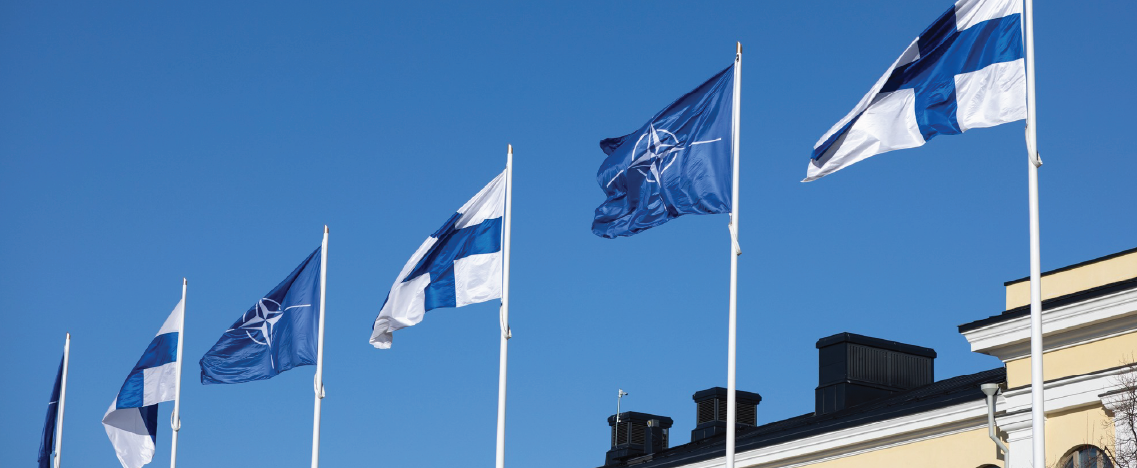
Image: Facebook | Valtioneuvosto