 A Nation Must Think Before it Acts
FPRI Experts React | Sanae Takaichi’s Victory in Japanese Election
A Nation Must Think Before it Acts
FPRI Experts React | Sanae Takaichi’s Victory in Japanese Election

A nation must think before it acts.

FPRI Experts React | Sanae Takaichi’s Victory in Japanese Election
Shihoko Goto—With Takaichi’s Massive Win, Japan’s Potential Path Forward Opens Up
The decisive electoral victory of Prime Minister Takaichi Sanae’s ruling party on February 8 was a clear win for a new wave of conservatism in Japan. The Liberal Democratic Party (LDP), which has been in power for most of the time since its founding in 1955, secured its biggest win in history, gaining 316 of the 465 seats in the powerful Lower House of the Diet. Moreover, as it remains committed to continuing a coalition government with the Ishin (Innovation) Party, which won thirty-four seats, the Takaichi administration has secured a two-thirds supermajority and, with it, a powerful mandate to steer the country as it confronts seismic shifts at home and across the globe.
As Japan’s first female leader, Takaichi is no stranger to being a trailblazer. Since taking office last October, she has been seen as the single biggest factor resulting in the LDP’s landslide victory. Takaichi’s appeal to voters has decreased because of the LDP, but despite it. The LDP had long struggled to cast itself as a dynamic party and a proponent for change. As a woman from a middle-class background with no family ties to politics, Takaichi is viewed as a breath of fresh air and a leader with a clear vision of how Japan needs to promote and protect itself in a rapidly changing world. Her message of a strong Japan resonated with younger voters in particular, with numerous polls finding over 90 percent of 18- to 19-year-olds supporting her personally.
The prime minister has made clear that Japan will need to bolster its defense capabilities as tense relations with China continue. With its supermajority in the powerful Lower House, the LDP has the power to pass bills that have been rejected by the Upper House. What’s more, some Japanese commentators have been quick to point out that the LDP now has the possibility of moving forward with constitutional reform, which first requires approval by a two-thirds majority in both houses of parliament, followed by a simple majority in a national referendum. No changes have been made to the constitution since it came into effect in 1947. Still, one possibility is that the Takaichi government might bring back the debate about revising Article 9 whereby the country renounced war as a sovereign right and restricted its military capabilities solely to a Self-Defense Force.
At the same time, the latest election also made clear that Takaichi’s belligerent stance toward China has not dampened voters’ support for her. Despite her declaration in early November that a Chinese attack on Taiwan would constitute a “survival-threatening situation” for Japan, Beijing has continued to step up its coercive actions toward Tokyo. Rather than backing down, however, Takaichi has maintained that her position is in line with Japan’s security policy and the US-Japan alliance. While China increased coercive action against Japan, including imposing export restrictions on dual-use technologies (including critical minerals) to Japan, public support for Takaichi’s firm stance against China has remained steady and clearly did not hurt her in the election.
As Takaichi prepares to meet with President Donald Trump in Washington next month, her decisive victory will make clear that not only is Japan a critical ally in the Indo-Pacific, but also that she herself is a winner. She will also have proven herself to be a force to be reckoned with, and a leader that has stood up to Chinese aggressions. That political capital and daring will be key in moving relations between Japan and the United States forward.
Mirna Galic—Takaichi’s Win Will Boost Regional Security
In addition to providing a public endorsement for Prime Minister Takaichi’s defense and security agenda, about which she has been very vocal since coming into office, the election’s creation of a coalition supermajority in the Diet will make it relatively easy for her to pass defense spending increases and relevant security legislation. The latter includes any enabling legislation needed for changes from this year’s planned revision of national security and defense strategy documents and update of export restrictions, Diet approval for the establishment of the new national intelligence secretariat Takaichi has championed, and an anti-espionage law to enhance safeguards in 2013’s Act on the Protection of Specially Designated Secrets. All of this is good news for Japan’s ally and partner relations.
Although the reconciliation of planned defense spending increases with tax cuts still needs clarification, greater defense spending in key areas would boost Japan’s relations with regional and global partners. More funding for bilateral and multilateral defense cooperation and exchanges in the region, for example, could increase or expand Self-Defense Force exercises with regional countries, further defense capacity-building efforts, and improve Japan’s visibility in regional waters and ports—all of which also contribute to deterrence and “burden sharing” within the US-Japan alliance. Similarly, greater funding for defense equipment and technology cooperation, along with the planned elimination of current limits on defense and technology transfers, would allow greater sharing of Japanese defense equipment regionally as well as increased efforts on joint development with both Indo-Pacific and Euro-Atlantic partners.
Improvements on the intelligence and espionage sides will also stand to benefit Japan’s relations and integration with both its ally and key partners. These include the kinds of intelligence sharing necessary for US support of Japan’s counterstrike authority and greater coordination between Japan’s new Joint Operations Command and the US Forces Japan/Joint Force Headquarters update expected later this year. Such changes would also bring Japan into greater alignment with Five Eyes standards, facilitating information sharing between Tokyo and network partners.
While legislative support for key initiatives is the clear victory from the landslide election, Takaichi will also read the public support it signals as a green light for parts of her agenda that do not require direct Diet cooperation, such as her assertive stance on China and increased diplomatic support for Taiwan. The public’s endorsement will also give Takaichi greater leeway as she navigates Tokyo’s “limitless” partnership with its US ally.
Jon Metzler—Takaichi Can Tackle Regional Revitalization in Earnest
Immediately before the election, Prime Minister Takaichi got about as good a present as a sitting prime minister could want: an in-person visit from Taiwan Semiconductor Manufacturing Company (TSMC) chairman and Chief Executive Officer C. C. Wei, accompanied by TSMC Japan Chief Executive Officer Onodera Makoto, to announce that TSMC would invest an estimated $17 billion into its Kumamoto, Kyushu, site and expand its footprint there to a gigafab site, and further, that TSMC would manufacture 3 nm logic chipsets there. In 2025, 3 nm was TSMC’s second largest process node by revenue (behind 5 nm) and will become its largest process node by revenue in a matter of time. Further, it is used by fabless chip companies such as NVIDIA, Apple, and AMD. The implications of the “gigafab” term are also thought-provoking and likely good news for both Kumamoto and Japan—gigafab sites, such as TSMC’s Tainan hub or its in-development Arizona hub, often also house assembly facilities, such as for TSMC’s CoWoS (chip-on-wafer-on-substrate) packaging services for artificial intelligence (AI) customers. While this was not part of last week’s announcement, if packaging does indeed become part of TSMC’s Kumamoto footprint, this would secure Kumamoto’s position as a global production and assembly hub in the AI era. A sitting prime minister heading into an election could hardly ask for better news.
With a supermajority in the Diet, Takaichi inherits a country that is aging, shrinking, and centralizing at the same time. It is an issue that impacts her native Nara—a lovely tourism destination but with an aging population. The trends are most visible in the countryside. Kumamoto’s population, for example, has held flat in recent years in part due to semiconductor job creation—this is an outperformance relative to other Kyushu prefectures (Fukuoka excepted), which are shrinking as Japan ages, shrinks, and centralizes. “Regional revitalization” was the defining policy issue of Takaichi’s predecessor Ishiba Shigeru before he became prime minister, which is what led to creation of a cabinet-level minister position dedicated to the issue (Shinzo Abe, who created the position to keep Ishiba in the fold, was engaging in a bit of a “cabinet of rivals” strategy, but the issue itself is very pressing).
Thus, extrapolating from Japan’s relative success to date in the implementation of its 2022 Economic Security Protection Act (ESPA)—as measured by both inducing TSMC to come to Kumamoto via the JASM joint venture with Sony Semiconductor, Toyota Motor, and DENSO, and TSMC’S subsequent additional commitment to production in Japan, as well as by the various forms of memory that will now be made in Japan, up to and including HBM (by Micron Japan in Hiroshima)—will we see similar placemaking strategies under Takaichi? ESPA has worked because, with the exception of Rapidus, which is building its logic foundry in Chitose, Hokkaido, it has mainly focused on augmenting and protecting sites with existing industrial, administrative, and academic capacity. Thus, looking forward, one wonders if we will see greater attempts to coordinate industry activity in different sectors. One can only have so many life sciences hubs, for example. So far, regional revitalization has mainly meant small pilots and testbeds, whereas ESPA has been big enough in scope and ambition to shape business behavior and decision-making.
Data centers need power, which points to another issue. Denuclearization in Japan has been entirely understandable in the wake of Fukushima but has also meant greater fossil fuel dependency and, in some areas, limited energy generation capacity. In the AI era, this is a pressing issue. As global hyperscalers deploy capacity, Japan’s ability to host AI data centers is limited. For time to market reasons, for capacity reasons, and for economic security reasons, Japan would be best suited by an “all of the above” energy strategy: wind, geothermal, solar, nuclear, fusion, liquified natural gas, and liquified petroleum gas as well.
Under Prime Minister Takaichi, Japan has already moved up its commitment to raise defense spending to 2 percent of gross domestic product by two years. US defense firms are eager to grow their footprints in Japan. Simultaneously, the same production backlogs that plague the United States affect Japan. Can Japan fill the gap with a mix of new domestic and US suppliers? Newer US defense startups are certainly eager. Will they be encouraged to partner with Japan’s primes? If so, can the primes move quickly? And with regard to innovation and entrepreneurship, will Japan continue the support of startups begun under Prime Minister Fumio Kishida? This is fostering meaningful cultural and business change, in addition to ties between Japan and global innovation hubs.
Finally, how else will Prime Minister Takaichi signal priorities? She has already adroitly hosted a “drum summit” with President Lee Jae Myung of South Korea. We recall when PM Abe came to Northern California and drove a Tesla powered by Panasonic batteries. In addition to showcasing the Japan Inside brand, it signaled to more conservative Japanese firms that it was okay to come to Silicon Valley, and partner with startups.
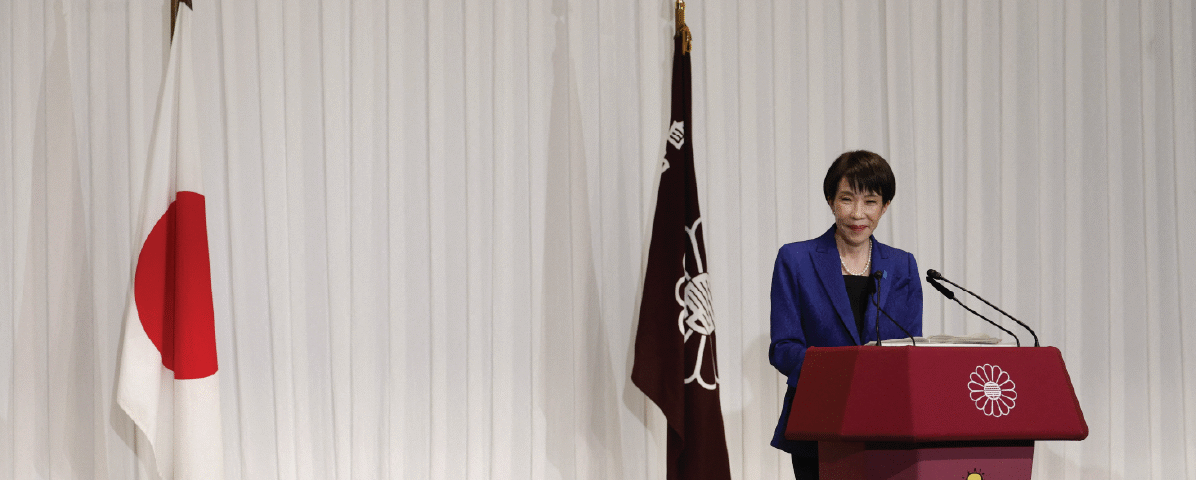
Image Credit: Japan’s Prime Minister Sanae Takaichi, leader of the ruling Liberal Democratic Party (LDP), speaks during a press conference at the LDP headquarters in Tokyo, Japan, 09 February, 2026. Japan’s ruling Liberal Democratic Party secured more than two-thirds of the seats in the House of Representatives in a historic landslide, giving Prime Minister Takaichi a strong mandate to advance her conservative policy agenda. (Franck Robichon | Pool via Reuters)