 A Nation Must Think Before it Acts
In Conversation with Adm. Rob Bauer and Eleonora Russell | If You Want Peace, Prepare for War
A Nation Must Think Before it Acts
In Conversation with Adm. Rob Bauer and Eleonora Russell | If You Want Peace, Prepare for War

A nation must think before it acts.
In Conversation with Adm. Rob Bauer and Eleonora Russell | If You Want Peace, Prepare for War
The following conversation was recorded on March 19, 2026 and has been edited for clarity. You can listen to the conversation here.
Natalia Kopytnik: Welcome back to The Ties That Bind, a project of the Foreign Policy Research Institute examining the past, present, and future of NATO and the transatlantic relationship. I’m Natalia Kopytnik, the Communications Director at FPRI, and this week I am very pleased to introduce a special episode of The Ties That Bind.
Now, throughout this series, we heard a lot about how individual NATO countries are thinking about and bolstering their defense and preparedness in an increasingly complicated security environment. But often these conversations are quite confined to a military and government context. After all, it is natural that we expect our leaders to think of our safety and plan accordingly. But do we really think about what our role as individuals would be in this context? My guests this week argue that no, we do not, but we really should.
I am very pleased to welcome to the podcast Admiral Rob Bauer and Eleonora Russell. Admiral Bauer was the 33rd chair of the NATO Military Committee from June 2021 until January 2025. He also previously served as the Chief of Defense of the Netherlands. Eleonora Russell served as a Strategic Communications Advisor to the NATO Military Committee and is an award-winning speechwriter. Together, they co-authored the 2025 book, If You Want Peace, Prepare for War: A Blueprint for Deterrence. We spoke about the core lessons from the book, what a whole-of-society approach really entails, how to effectively rebuild trust and engage citizens and industry leaders, and what the future of the Alliance may look like if we overcome the mentality that military strength alone will keep us safe.
Thank you both so much for taking the time to join us today on The Ties That Bind.
Adm. Rob Bauer: Hello, Natalia. Nice to be there.
Eleonora Russell: Thank you for having us.
NK: So, of course, among many things, I wanted to talk about your book, which was released last year, If You Want Peace, Prepare for War: A Blueprint for Deterrence, which outlines the seven lessons for bolstering security and preparedness. At first glance, one would think this would be a more tactical, military strategy book, but as a non-military expert, I really enjoyed the framing of this book. It really encompasses practical advice for everyone: for politicians, for business leaders, for civilians. And, as I understand it, the book was based on a speech that you both worked on that Admiral Bauer gave 2023.
To set the scene, at that moment, what was the impetus for the speech? What was the initial reaction from the audience? Did you expect at that time that it would be so impactful that it would evolve into a book?
RB: Well, of course, when we gave the speech in February 2023, we were about a year into the full-scale war in Ukraine.
And in that year, my conclusion was that the military plans in NATO, from the strategies down to the tactical plans, were revised. That was a lot of work, but it had been done. And in the Vilnius summit, we agreed to the regional plans, even. So basically, there was a lot of thinking done in the military in NATO, and the discussion we had was, “Okay, if the armed forces are restored to the strength they need, are we there? Is that sufficient?” The answer of that discussion was no,
because we also need an industry that can produce [during] peak demand signals. And we need a financial sector that is willing to invest in the defense industry. And we need people to be more resilient: so, [we need] this idea of a more whole-of-society approach, where everybody needs to understand they play a role in preventing war. And of course, if it is war, everybody plays a role, as we see in Ukraine.
Very important to prevent war: you need to be resilient. If you are resilient, then you will be more successful in your deterrence. Because if your opponent sees that everything works and is strong and can withstand a shock, it is more difficult for them to win. So that idea resulted in the speech in February 2023. I think it was received well. It didn’t go viral at the time—it got some attention, but it didn’t go viral. But for us, it was the starting point of the book.
The lessons, we can be rightfully proud of ourselves in a way, because more than a year into the Trump administration, [with] the wars that are going on in Venezuela, and the threats to Greenland, and the war with Iran, all the lessons that are in the book are still valid, still important to learn and to implement. In that sense, although a lot has changed, the book is actually still viable.
The other thing we are extremely proud of is that the book is now translated into Ukrainian and will be published in Ukraine in April.
ER: We really tried to make this an accessible book, easy to read for everybody, because the topics are very heavy and big. So we wanted the language not to be that—that’s why it reads like a speech. And if there’s one thing that we really hope that people will feel after reading it, is that not only that they need to do something but also that they can do something.
The world being as it is—and we’ll talk more about that in this podcast—it can leave people with a sense of fear and a sense of paralysis of, “I have no idea how to and what my role in all of this can be.”
What the book is about is how to make yourself stronger, how to make the community of which you are a part of the stronger, and by doing that lowering the chance of minimizing the chance of war happening to you. And then if it should still happen, that you win it very fast, because we will win it. We have no doubt about that.
NK: That’s what I took away from it, and it was a very enjoyable read.
ER: Thank you for that because they are very heavy topics.
NK: It was extremely accessible. So, for me personally, I think the two chapters that really resonated—and I think will resonate also with our listeners, because they talk much more about human character and behavior, and, as you mentioned, the need for community, which is somewhat rare in discussions of security and foreign policy often. Admiral Bauer, you said in the book that the responsibility for protecting freedom does not rest solely on the shoulders of those in uniform, because war is a whole-of-society event, so preparation for war must also be a whole-of-society event. In your view, what does that a civilian who has embraced that sense of responsibility look like now in 2026?
RB: You have to go back a little bit into history. I think around the early 1990s, we started to outsource a lot of government functions to business. And that was for reasons of efficiency, because everybody thought that the private sector would be better and cheaper in everything. So healthcare went that way, public transport went that way, energy production went that way.
So many, many areas where the government was the provider and the guarantor of those services went to businesses and to the private sector. In a way, we have outsourced, also in the minds of people, security to the armed forces. And people literally tell me, “I pay taxes and therefore, you provide security for me.”
The fascinating thing is that when there is a war, the professional soldiers will go to war for us. People should not have any doubt about that. But the unfortunate thing about war is that soldiers die and soldiers get wounded. And then where do you think we will look for new soldiers? It is in our nations. It is amongst the younger people and the able people in our nations to become soldiers because it is us that should defend our nations, not the armed forces. It is us.
And, of course, you have a group that does the work and is trained and is able to work with all the weapon systems and the ammunition and the airplanes and the ships and the tanks. But society as a whole is responsible for our security and for many other functions in our society, by the way. So, I think that is one of the big changes that needs to happen, that we get out of this mode of individualism and “It’s all about me. It’s all about how someone else will solve my problem.”
Everybody’s angry at the government, when a lot of people actually can do something themselves and then help not only themselves, but also society. Things like part-time working is not a right. It’s a luxury. So, when you talk about taking responsibility—I spoke to a producer of weapons in Ukraine, and I asked him, “How many hours do your employees work?” And he said, “240 hours per month, 20 days a month, 12 hours per day.” That is more, much more, almost double of what European nations produce. And the reason is simple, because people in Ukraine that are not in the armed forces, that group is shrinking because of the people that die and get wounded and more and more soldiers need to go up to the front.
Therefore, the people that are available to do all the other things like education and healthcare and administration and business, that group is shrinking. Therefore, the people that are in that group need to work harder. It’s very, very simple. And nobody talks about it in a negative way in Ukraine. Everybody understands this is necessary.
I think all these examples [show that] we want a lot. We want to save the planet. We want to have our part-time work week and have fun because people say, “I’m not living to work. I want to have some time and I want to enjoy life.” I hope people can have that. But it is a luxury in a way, because now the time is such that I think we need to do more together to make our societies stronger, including the armed forces. But there’s much more that needs to become stronger.
ER: There are so many ways in which you can serve your country. If you work at an energy company, if you work at a supermarket, if you work in water supply, if you work at the municipality—wherever you work, most likely you are in one way or another supplying a good or a service that keeps your country running. And if you can make sure that you talk to your colleagues at work about, “What are we going to do if war comes to us? Are we prepared? How are we going to make sure that we keep on supplying what we always supply?” then you are serving your country.
So, it’s not only about defense. It’s not only about conscription or reservists. It’s such a broad task for everybody. That’s one part.
And then if you zoom in on an individual level, it’s about making sure that in your own household you have enough to survive, for instance, a couple of days without electricity, that you don’t immediately have to lean on supplies that are given to you by the government because they might not be there.
So, you need to make sure that you can hold your own for a couple of days and that you can help your neighbors. Talk to your family, talk to your family members that you know might be struggling, make a plan, and talk to each other. “Okay, if we can’t reach each other by phone, are we going to come to your house or my house? Better that we talk about that now because we may not be able to reach each other.” It sounds scary, and it sounds maybe to some people ridiculous, but it can give you so much of a sense of, “We have a plan. There’s security. I’m part of a group and the group will take care of me and I will take care of the group.”
RB: It’s not just about war. This is also about Spain that had ten hours without electricity. It’s about Berlin that went four and a half days without electricity. So, this is not a war scenario per se. This is also a part of normal life. The people in Finland and Norway and Sweden, they live in an area where because of snow or storms or bad weather, you might be isolated. Therefore, you better have some water and some batteries and some wood. For them, it’s normal. And therefore, it’s not, “Oh my God, you have to prepare for war.” No, no.
Also, if it’s war, it’s good to have [these things]. But in normal life, you might need it too.
NK: Yes, or not just to assume that someone else is going to take care of that for you. I think that is a natural segue to the other chapter that really stood out to me, which was, I think, the central theme of this book: reframing one’s point of view from, like you said, an individualistic, self-centered, self-interested context, and putting oneself in the context of community. So as you say, “fighting for the we in a world of me.”
And I think naturally another factor in all of this is trust: trusting entrepreneurs and industry leaders to make the right investments and make the right calls, military leaders to make the right plans. But it’s also ultimately about citizens trusting one another and trusting their institutions.
Unfortunately, we see that the trend over the past few decades has been that there is a real decrease in trust in institutions and specifically in government. In the US, Pew Research Center does a study—I think they’ve been doing it since 1958—where they ask how many Americans trust their government to do the right thing. Last year, only 17 percent trusted the government to do the right thing, which is a very low number. I think when they first asked it in the 1950s it was something like 70 percent. Also, 44 percent of US respondents said that they don’t trust their fellow citizens. That’s also quite stark.
But in general, these numbers show that there is a real scarcity of trust. And if there’s a scarcity of trust, that compromises the ability for leaders to carry out plans, services, and for people to have that collective sense of responsibility. So, Admiral Bauer, I’ll start with you.
What do you think, how does a prepared leader make the case for civilian preparedness, for people taking that responsibility, and for persuading them to “fight for we in a world of me?”
RB: I think the lack of trust is part of this move to individualism. So because we thought we would need nobody other than “me,” and everything is focused and is centered around “me,” and I can organize everything and I normally get what I want. And if all these things mean that if there is someone else saying, “Hey, we need to organize things in this country as well. We need roads, and we need healthcare care, and we need all sorts of things therefore we want you to pay taxes” and then people say, “No, no, no, I don’t want to pay taxes to the things you want to spend it on. I want to spend everything on the things I want.” So, I think there is a connection between this distrust of the government and individualism.
Because people for a long time thought they didn’t need anybody else but themselves. And I think that is wrong. I think a society is not the sum of all these individuals. It is much more than that. You see actually with the pandemic, for example, but also in a war or in another crisis, that people actually understand this, and they start to help each other.
Then they automatically move away from this system where people also believed that everything was available. So if you open the tap, there’s water. If you put a plug in the electricity, you have electricity. Everything always works. People think that’s normal, but it isn’t. And therefore, we are spoiled in many ways.
So, if things go wrong for whatever reason, like we saw in the pandemic, then actually the interesting thing is that people start to help each other. That’s basically what we say in the book as well.Look after each other, help each other.
Of course, there are things that are too big to organize as individuals. That’s why the government does that for you. And I know there in the US, the federal government has a negative perception, and people [don’t] want to have that close to home. But even then, your municipality needs some money for running the roads and the ambulances, and then people are angry because they have to pay. Come on, guys, if you want a functioning country, then you need some organization, which is the government.
But in a way, we have neglected this, I think. And we haven’t done any maintenance to our democracies in the last 40, 50 years, because we thought it was such a good concept that you actually didn’t have to do anything to maintain it. But everybody who is in a relationship knows it’s hard work and you need to invest in a relationship and you need to make sure that everybody believes that everybody is doing their utmost to make the relationship, in this case, the democracy, our country, work properly.
NK: Yeah, definitely. It’s a two-way street, not a one-way street.
ER: Just about that point about democracy being under threat, both from outside and from the inside—the threat of war is one of the few things that bring people together. It’s immensely difficult to bring a polarized society together because there are all sorts of economical, historical, political reasons why that evolved into the way it is. And then a large outside threat like the threat that we are now facing can also be in a way—in a horrible way—an opportunity to find those things that unite us and to work together, to learn step by step, to trust each other again.
And that starts with what we were talking about earlier: about companies being ready, about companies trusting the government again, about government trusting citizens, citizens trusting the government. It starts with small steps, but it can also be a way to bring everybody together again. If we do that, we minimize the chances of our adversaries attacking us because they are watching, they are using and abusing the polarization that is already out there. And they are watching very, very closely how we behave to every single new development. So there’s a real chance of preventing war if we start trusting each other again.
NK: I think that also speaks to the importance of effective communication, which is also a central theme of the book. So perhaps I’ll turn to you, Eleonora, here. In the book, you include a great quote, which I’m forgetting that the source, but it was basically, “The first casualty of war is truth.”
And you point out the examples of Russia’s war against Ukraine. But now also we see this, right, with the American-Israeli war with Iran. We’ve seen the just onslaught of misinformation, disinformation, AI-generated videos of military action, of drone wreckage, of explosions that are all fake.
It’s just overall eroding trust right in verified reporting in official statements. In the Gulf, some governments have said, “You’re going to get really high fines or even jail time if you are caught spreading this kind of content,” because they want people to only consult government-run accounts. But of course, these tactics are limited in the NATO context. But it does seem like the line between who owns truth is really getting blurred.
You know firsthand how much language plays a role in shaping strategy and how important it is to craft the right messaging—in your view, how do government leaders own or protect the truth in this very complicated information environment without limiting the freedoms and the rights that obviously define our societies?
ER: There are many sides to this. One is that governments need to invest in the capability but to push back on fake news that is out there and to push the big tech companies to invest in that capability as well, because it is possible. It’s just a matter of making sure that there are departments of people working on that. That’s one point, because we see with the rapid increase in technology, the deepfakes that were disseminated at the start of the large-scale war in Ukraine—if you look at those now, you think, “wow, that’s outdated,” because the deepfakes that are coming in now about what is happening in the Middle East are already so much more evolved. It’s going very, very fast. So that makes that investment of resources crucial.
But there’s another side to this that, if you talk about what the leaders need to do, and I believe that this is not only government leaders, but leaders across the board need to do as well, is there needs to be more leaders who are honest. And when I say honest, I mean really honest in their messaging.
You need to be consistent. That’s one part of it, because if you’re consistent, if there is fake news surrounding a statement that you’ve made, people will start to notice it because it’s so far off from how you normally behave and what you normally say.
But the honesty element is also very crucial because if there is a large gap between polished politicians or CEOs and the influencers that are almost proud of being ignorant, but they’re unpolished, therefore they are “better than,” that can also create distrust. So I think leaders need to not worry so much about being polished and taking zero risks. There are way too many people who do my job, who work in PR and make everything look better than it is. And people see through that. They know when you’re bullshitting them. They appreciate it if you say, “You know what, I can’t answer that because I don’t know.” Or, “I’m so angry about what just happened. I’m so disappointed.” Show emotions, be yourself, and people will respect that. They may not always agree with you, but they will take you seriously.
NK: Admiral Bauer, you mentioned an example in the book about a moment of communicating honestly, I believe it was while you were the Chief of Defense in the Netherlands, about a delay in a delivery, if I’m recalling correctly, and you thought that when you were relaying this information, people would be angry or upset. But actually, they were shocked that you were just being honest about the situation and doing your best to resolve it.
RB: Yeah, so I expected disappointment from them and anger. Then most of them came to me in the first break during those meetings and said, “Rob, it’s amazing that you told us this. And you are the first one who actually tells us about your problems.” But basically, we all have the same problem. And so it’s good to actually talk about this and be honest with each other about our real problem.
Because there is a tendency amongst nations to say, “No, no, no everything is fine. Everything is fine. Don’t you worry. I will have the troops. I will have the capabilities. I will have the ammunition when the war starts.” And then when the war starts, the Supreme Allied Commander Europe, who is to fight for us with our troops and our capabilities, finds out then that he will get only 75 percent. I’m not saying that is the percentage, but he might find out he has less troops available and less ammunition than everybody promised. And that’s wrong. It is wrong to make things more beautiful when it comes to a serious subject such as security. I understand we’re not going to tell President Putin everything about NATO when it comes to our weaknesses and our concerns, but amongst ourselves, we should talk about them.
So one of the fascinating things I believe is that the people are very anti-government or that are not trustworthy of their government and are skeptical of what the government is doing and they don’t want the government to interfere with their lives—that group is actually the same group that will be angry if things have not been arranged when the war starts. And so, they don’t want to be involved. They don’t want to do anything. But at the same time, I’m pretty sure that when the war starts and things have not been organized properly, it is that same group that will be angry at the government that they haven’t prepared. So it’s even more mind boggling that people have two faces in that respect.
NK: Speaking of organizing efficiently, one of the chapters that was in the book is about the issue of efficiency and effectiveness, right? It was quite shocking, actually, to read about all of the layers of bureaucracy and standardization that bogged down things that should be a lot more straightforward.
You talk a lot about business leaders and how they play a role in that. But on that note, have you seen any positive examples of things changing for the better on that front, where there is increased efficiency, even in one industry or one area or process since you’ve written the book?
RB: I think there is some movement away from efficiency. People started to understand that efficiency thinking now, after so many years, has a negative effect on the strategic effectiveness of our nations.
And the reason is because, if you have an economy that builds just in time, just enough, that is the same as [if you were to] order your car at the dealer and he can tell you that your car will be delivered in the fourth quarter of 2026 because you have this very special model and with all the extras. And they tell you it will be delivered in December 2026, even though the date is [only] most likely. And the reason is that when you order the car, it is put into the production system and therefore they can fill the whole production system, which is perfect because it is extremely efficient.
But the problem we are looking at, with the pandemic, when it was about medical supplies, and in a war with the military, is that we say, “I don’t want my car in the fourth quarter of 2026. I want 1,000 cars next week.” And the industry and our society is unable, until today, to actually deliver to that peak demand signal.
Because we simply do not have the structure, we don’t have the workers, we do not have the capacity to do it, and we are in year five of the war in Ukraine. Still—there’s improvement, there are more factories coming and production capacity is going up, but not at the pace you actually need when you are in a war. So, you need to produce not just when it is possible, you need to do it just in case. You need to have stocks, you need to make sure there is enough ammunition, that there are enough spare parts. All these issues are then connected to production times that are extremely long.
The Patriot missile production is one and a half years. So if you have stock for one and a half years, you’re okay. But if you have stocks for 30 days and the production time is one and a half years, you are in serious trouble.
ER: In terms of the good news—that’s my role always in the conversation—is that you see (there’s definitely still a huge problem in the defense industry) across industries at large that the topic of resilience, the topic of preparing for war is [increasingly] becoming a boardroom topic.
CFOs are realizing that this goes well beyond crisis management of a temporary interruption of your normal business activity, it’s a strategic topic that the company needs to think about. So that’s very positive. There’s a big willingness to think about it and to invest. But there’s sort of a public-private dance going on where both sides are waiting on the other to act first. And that’s our job right now. Our daily work is trying to bring them together and make those two sides trust each other and persuade them to make that first step. But there’s definitely a lot more awareness and a sense of urgency than there was a couple of years ago.
If I can give you one small example that gives me hope. There’s an energy company in the Netherlands that decided to give all of its maintenance people a special course in how to open an elevator in case of a power outage because thousands of people in the Netherlands might be stuck in an elevator. The firefighters have to do, of course, a lot of things at the same time. So if they don’t have to worry about the people in elevators, that saves them an immense [amount of time] and therefore saves lives.
If those maintenance people have that ability to open the elevator, then that makes the job of the firefighter so much easier. So, it’s not always about huge investments. It can also be about using capacity that is already out there, but using it in a way that you do something good for society as a whole and not only for your company.
NK: You mentioned how war and resilience are making their way into the conversation also on the industry level, not just in closed political and security conversations. And you dedicated the book to the people of Ukraine going into the fifth year of war. As you mentioned in the book, Ukrainians are constantly shifting between this concept of “What do I want the situation to look like?” and “What does it actually look like?” And it’s this combination of idealism and realism that allows a society to constantly adapt to changing circumstances, be prepared for anything, but also still all work towards the same thing, the bigger picture, which is ultimately victory, right?
Now, in the West, we do have more of those conversations about resilience, because that’s how we define this whole concept in the West: under this umbrella term of resilience. But for many still, as normal citizens, the concept of war still does feel far away, either geographically, generationally, culturally. I think for North Americans specifically, I don’t think there is that collective generational experience of what living through a war means outside, of course, of military personnel. Because for Americans, wars are removed. They’re fought far away. Their aims are often nebulous. There is no military draft anymore. So it’s a bit remote. The main reference point for this concept of resilience for Westerners is that you learn if you are or aren’t resilient only when you’re put in that situation, and only when the war actually comes knocking at your door.
So, how can leaders explain the concept of resilience as something worth investing in and nurturing during times of peacetime?
RB: I think, and I don’t know whether people in the US feel this, but I would say in cyber, you could say we are at war. Russia and China are attacking the US, the Netherlands, and the whole world daily with enormous amounts of attacks. For Russians, most of the time they are preparing for war because they want to nest in systems. Whether it’s energy, whether it is hospitals, whether it is industry, they want to be there to disrupt—once the war starts—from a distance the systems that basically make sure that our societies work and function.
The Chinese do that too, most of the time they steal information and intellectual property. So, it has more economic motives. There are examples in the US where, I think, a pipeline system or where serious cyber attacks were disrupting the daily lives of people. This is already going on. People should understand it’s not complete peace any longer. And if you look at disinformation, I think we are also in a way, in war, because there is so much disinformation out there where people should really be concerned about, as we talked about earlier, what is the truth? What are the facts?
It is much more difficult now than a couple of years ago to find that. And then for companies, for example, if there is a war somewhere else, it might or most likely will have an effect on your supply chain. Because the IKEA CEO found out on the day the sanctions hit Russia that 25 percent of his supply, wood for the BILLY bookcase, came from Russia. Therefore, overnight, he had to find for one quarter of his raw material a new supplier. So, you don’t have to be at war to be seriously touched in a negative way, influenced by war. And I think the people in the United States now find out when they try to put gas in their car that the price of gasoline has gone up dramatically.
So people will find out, because so many things are connected in our world, that when the war in the Middle East is now fought, that it has an effect on our oil prices and gas prices, and therefore has an impact on the price of heating your house, driving your car, and all these things. Some products are not coming as fast as usual because they have to sail around South Africa now because they can’t go through the Suez Canal. All these things have an impact. And then, yes, indeed, there’s no war in the US, but there is an impact of that war.
ER: The way that we look at it, the biggest problem is not so much a lack of a sense of urgency. I think the sense of urgency is there also in North America. I’m more concerned about a lack of confidence in our ability to do something about it.
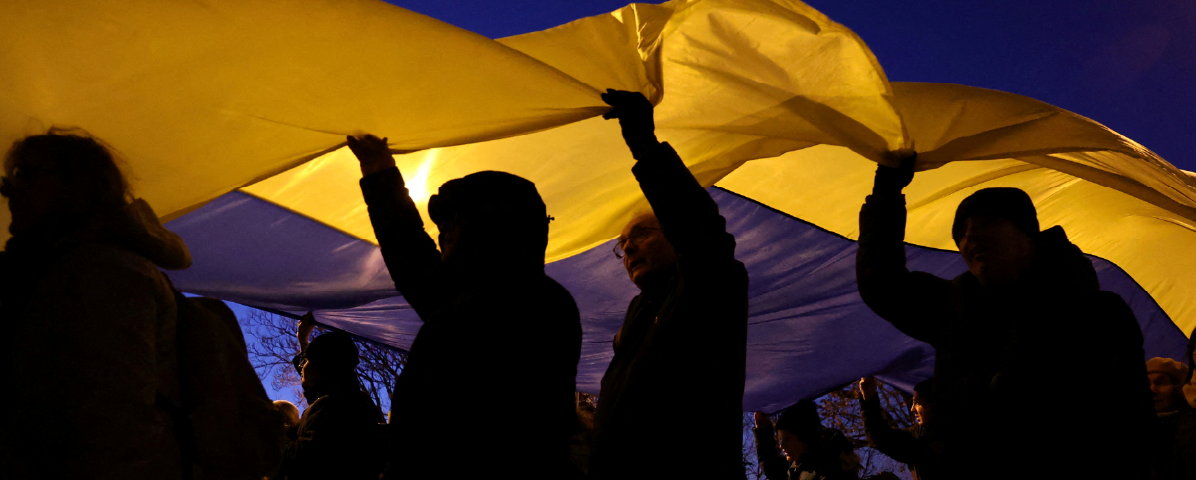
And that’s something that you see across North America and Europe: a lack of confidence. And that’s why it’s so important to look and learn and be inspired by what the people of Ukraine are doing, because they are showing us every day what people can do if the unthinkable happens.
There’s this story that we always tell in the theater show that we do in the Netherlands about this topic. It’s the story of a little girl called Erika, who was six years old when her father passed away in the war and was killed at the front. She was six years old and she thought, “What can I do? My father’s unit is still fighting. What can I do?” She started making these little headbands, flowers, and she sold so many of them that she saved enough money to buy multiple rocket launchers, vehicles for her father’s unit. If a six-year-old girl in Ukraine can do that, who has just lost her father in a war, then how can we, in our position of immense privilege, having decades of peace, how come we think that we have nothing to offer, that we are weak and we can’t possibly face the world around us? That’s something that we try to push as much as we can, because people need to realize how strong they are.
RB: But it’s fascinating, you have those influencers in Dubai and they basically escaped many nations because they didn’t wanna pay taxes. And then the war started in Iran and Iran retaliated also to the UAE (United Arab Emirates), and now those people are in danger.
And then they demand from their former country—because basically they left because they didn’t want to pay any taxes—to be picked up by the armed forces.
And so, it is so interesting how privileged we are and how far away we are from understanding that it is not given. It’s not a privilege. All these things need to be arranged and all these things take effort and all these things cost money. If you want your government to pick you up with an aircraft, the armed forces need to have those aircrafts and you need to have pilots that can actually do the work.
People don’t understand that it takes time and that it is an effort. It’s not a given. People think it is there when they need it. Until they don’t need it, they don’t want to buy it, they don’t want to pay for it, they don’t want to be involved, but suddenly they want it.
And the same is with a lot of people that talk about the environment. They want the refinery out of their nation, the chemical industry out of their nation because it is dirty, but they still want all the products. They want the plastic cups and they want the gas and they want all the things that are produced there. But “not in my backyard,” they don’t want it close to them.
NK: Well, since you brought up Dubai influencers naturally, my next question is thinking about the next generations, the younger generations.
Something that you mentioned in the book is that if we do not have an active memory of an event or feel an emotional connection to it, we often misjudge its risk. And I feel like that really stuck with me because, as we started this project with the 75th anniversary of NATO, there was a lot of talk about, “What does the next era hold? What does the future generation of NATO leaders or generally leaders in all these countries look like?”
And I think younger generations both in Europe and in the US, lack the kind of Cold War memories that really served as a founding principle of the Alliance. So, there are not these obvious reasons for supporting the things that NATO stands for. There are so many other problems in the world, in these countries. Younger people have to deal with economic instability, the polarization of the political system, and the impact of technology on our lives. So, sometimes these historic alliances seem a bit outdated or abstract.
How can we more clearly connect the achievements of NATO being a force for global security all of these 75-plus years, all of the good that has come out of that—how do we connect that with the palpable concerns of younger generations to get their buy-in? Because I think without their buy-in, NATO’s long-term survival and success might be under question in a few generations.
RB: I think one of the things is that my generation–I started in the Navy in 1981. It was the height of the Cold War. And then we basically were more successful than communism, and that led to the implosion of the Warsaw Pact and the Soviet Union. And then we thought this was the “End of History” by Fukuyama. Basically, we thought it’s democracy that has won, and therefore this is it. Until eternity, this is the situation.
And then that generation has seen no victories, actually. That is the sad thing. They saw the pandemic, and they saw wars in Afghanistan and in Iraq that were not successful. And they saw all sorts of things that were basically worrying and they are worried about climate change. So there’s depression-type thinking. And maybe people therefore flee to this idea that you need to also do a lot of fun things because you never know what the results [will be].
But I think if you look at the younger people now, not the millennial, but the people that are now between, let’s say, 15 and 25, they sort of understand that they are part of the solution. I find that very promising. I think they understand that the world is changing and that they have to play a role and that they are important in the solution. I have high hopes for the younger generation, actually.
ER: Don’t forget there’s 3.5 million young people serving in, mostly young people, armed forces across the Alliance. And that number is growing because armed forces across the Alliance are growing. And those people in the past may have had to explain to their friends and families why they did what they did. But since after all the world events in the last couple of years, they don’t have to explain anymore.
Everybody knows why what they do is extremely important. And that means there’s a ripple effect that comes from that, that I think a lot of young people want to do something for the greater good and realize that it’s necessary. They want to do work that matters, that has an impact in the world. It’s not only about what they pay you, it’s about what you contribute to in your daily work. So I’m very hopeful, to be honest. If you look at polling across NATO, there’s a lot of support for NATO across the Alliance in the younger segments.
NK: Well, it’s good to perhaps end on a hopeful note. Before we conclude, at the end of these conversations, I always like to ask my guests to reflect on their home country’s path towards NATO membership and what that moment in time of a session looked like. But of course, with the Netherlands, that would be unfair since none of us were alive then, when the Netherlands joined as a founding member in 1949.
But instead, I’d love to hear, just to close out, about both of your careers in NATO: if there was a moment that stood out to you, and you really felt like this is what it all was for, a moment that perhaps gave you hope and made you also proud to be a part of it.
RB: For me, that was the response from NATO and the EU after the full-fledged invasion. I think everyone was focused and willing to help Ukraine and to not give in to the Russian aggression. [I was proud of] the fact that NATO was adding value to our societies because of the need for more security and the rising threat.
I think the years that Eleonora and I were in the NATO headquarters were basically very positive years in the sense that all the nations were working together very closely and were very united with regard to Ukraine. There’s now more cracks, not because we left, but because of other situations. But yeah, I think those were very special moments.
And then an incident in that period was, for example, when there was a missile that hit a house in Poland. It was in November 2022. The great thing was that people expected that everybody was going to scream about Article V, but actually the Polish government and the Alliance—it happened in the middle of the night in a remote area. It was bad weather. So everybody said, let’s find out first what happened. And everybody took the time to find out what had happened. Then the next day, there was a meeting of the North Atlantic Council. And the conclusion was it was a Ukrainian air defense missile that went off course into Poland whilst, of course, trying to hit Russian cruise missiles that were attacking Ukraine.
So, the responsibility was still with Putin because they attacked Ukraine. But of course, these things happen. And therefore, we didn’t start a war because of that, but we took the time to act responsibly.
ER: There’s this quote from former Deputy Supreme Allied Commander General Bernard Montgomery upon the creation of NATO. He says that if we would have had NATO before, we would have been able to prevent the first and second World Wars, and in its creation lies the best hope we have in preventing a third. That was true in 1949, and it’s very much still true today.
Working for NATO, traveling the world, the Admiral traveled to all of the 32 Allied nations, plus I think 27 partner nations—all in all, about 200 trips in the three and a half years. And everywhere [he went], whether it’s NATO or a NATO partner, people believed in that and people saw that. And that’s still there, despite the—as the Admiral rightly says—difficulties that there are in a relationship. That belief, I feel, to the core is still there. Well, it’s certainly still there in us. I hope it’s there in you, that belief. It’s something so unique in the world that armed forces are able to trust each other to this extent, that nations are able to trust each other with their lives.
NATO is a life and death organization. That’s what sets it apart from the UN, from the EU, from the OSCE (Organization for Security and Cooperation in Europe). It’s something we need to be extremely thankful for.
NK: Admiral Bauer, Eleonora, thank you so much for such a thought-provoking conversation and sharing your insights with us today.
The book is If You Want Peace, Prepare for War: A Blueprint for Deterrence. And if there’s anything that you take away from it is that sometimes a great place to start is to just look in the mirror. So thanks so much again for joining us today on The Ties That Bind.
RB: Thank you very much, Natalia.
ER: Thank you, Natalia.