 A Nation Must Think Before it Acts
Who is the Kremlin’s Favored Candidate in the US Presidential Election?
A Nation Must Think Before it Acts
Who is the Kremlin’s Favored Candidate in the US Presidential Election?

A nation must think before it acts.

Who is the Kremlin’s Favored Candidate in the US Presidential Election?
As the US presidential election approaches, the Kremlin has been unusually dismissive of American politics, maintaining the appearance of skeptical disinterest, even as Vladimir Putin, apparently jokingly, has said he supports Kamala Harris. However, both the official detachment and preference for Harris aim to mislead. Moscow is still very much interested in who the next US president will be, and that person’s position on Ukraine—the key interest for the Kremlin and Putin—is the crux of the matter.
The Kremlin’s Public Act
There is a view among Russian, liberal-minded social scientists that the Russian state’s self-image is based on contrasting itself with the United States, its “constituting other.” The significant efforts of the Russian government dedicated to criticizing the United States and presenting it as the main threat to Russian sovereignty and even antithesis to its civilization give credit to this view. However, in the recent months, there has been a noticeable decrease in the amount of attention that Russian politicians, state media, and experts paid to the US presidential campaign, which would normally not be the case.
It would be naive to assume that the Kremlin lost interest, as this decrease would suggest on face value. Review of what the Kremlin’s activities with regards to the US elections shows that many of the components of its multifaceted strategy to influence US politics remain the same: covert and overt online disinformation and influence campaigns, which now increasingly rely on artificial intelligence, leveraging fake social media accounts, and cyberattacks. However, the facade of disinterest is a new component, suggesting that the Kremlin has learned from previous mistakes and is trying more subtle tactics.
For instance, in a January 2024 interview, when US President Joe Biden and former President Donald Trump were still the presumptive nominees of the Democratic and Republican parties, Russian president Vladimir Putin surprised many observers saying that Moscow favored Biden as the winner of the upcoming election. Putin explained that Biden was a “more experienced, more predictable” politician, representing a more stable, “old formation” of US leaders. Eyebrows were raised given that, in the past, Russia had been supporting Trump so brazenly that the latter’s victory was marred by allegations of collusion with Russia, warranting in a special prosecutor’s investigation. Did Biden’s predictability really change Putin’s opinion?
Putin’s comment also stood in stark contrast with the assessment of the US government officials and cyber experts who said, back in February, that Russia’s 2024 election interference had already begun and it was targeting president Biden and members of the Democratic Party. During the February 2024 Texas border crisis, a concerted effort by numerous Russian state actors, as well as suspect Texan social media accounts (potentially linked to Russia), was made to frame the situation as the US “new civil war” and push for an independence referendum in Texas. This effort marked an escalation of interference on behalf of the Kremlin, according to Logically, a company that uses AI to track disinformation online. A few months later, the Office of the Director of National Intelligence confirmed the US intelligence assessment that Russia still preferred Trump, not Biden, as the winner of the presidential election.
After Biden dropped out from the race on July 21 and Vice President Kamala Harris became the presumptive nominee of the Democratic Party, the Kremlin first maintained skeptical reserve. Putin’s spokesperson, Dmitry Peskov, made only a brief albeit prickly comment about Harris: “At the moment, we cannot assess Harris’s potential candidacy, since so far we have not seen any contribution from her to bilateral relations.” He also added that there were “some statements [by Harris] that were full of unfriendly rhetoric, but so far we have not recorded any positive or negative actions.”
But later in September, speaking at the Eastern Economic Forum, Putin surprised many observers again, noting that after Biden’s withdrawal from the race Moscow’s “support” would go to his successor, Harris. Putin complimented Harris’s “infectious laughter” and expressed hope that under her leadership, relations between Washington and Moscow might change. He also criticized Trump, who “imposed so many restrictions and sanctions on Russia that no president has ever imposed before,” suggesting that Harris might “refrain from this kind of action.”
Given these conflicting narratives and facts, whom does Moscow really favor?
The View from Moscow
If one takes cues from Russian state television, there is little doubt that Trump is the favorite. He is portrayed as a fighter for traditional values—a key tenet of the Putin regime—while Harris is derided as a supporter of transgender people and other minorities. Trump’s skepticism about US support for Ukraine is another issue that yields favorable nods from the regime’s media, whereas the assumption that Harris will continue Biden’s policy on Ukraine triggers the opposite reaction.
In the Russian expert community, opinions are mixed about which candidate would be preferable for Russia, but the assessments are mostly negative. One scholar of American politics argued that Trump is a better option for Russia due to his conservative views. “Trump believes that the Cold War must be ended. [Russia] is not a communist or left-wing state. Russia is a capitalist country, which means one capital must get along with another. This is Trump’s position. Harris is a real leftist… Ideologically, we are completely different,” he said. The scholar also saw Harris as a weak politician, who is not interested in foreign policy, not independent in her policy positions, and “not capable of turning things around.”
Another political scientist agreed that Harris “would be the weaker president,” who will continue the Democrats’ policy of “empty promises,” but concluded that for that reason a Harris presidency would be better for Russia. Yet another, more pragmatic view of Harris favors her for the Kremlin despite ideological differences and echoes Putin’s statement on predictability of the Democratic administration.
One pro-regime political expert pointed out that Harris is unlikely to agree to any of Russia’s terms for the Ukraine peace deal, but neither is Trump who is also likely to resort to blackmail and potential escalation. Trump’s main advantage for Russia, he reasoned, is the weakening of US relations with allies, including in Europe, while under Harris, Moscow expects the allies to consolidate—a negative outcome. Thus, neither option is good for Russia.
A similar view is espoused by a foreign policy expert with close ties to the Russian Foreign Ministry: “A possible Trump victory in the 2024 election will change little for Russia,” he argued, warning of no “deal” between Russia and the United States under Trump. According to his view, Moscow doesn’t care who the next US president will be, because in foreign policy, “there has long been an inter-party consensus on Russia.”
The main takeaway from these discussions is that bilateral relations are at such a low point that for Moscow to favor one candidate over another is pointless. But is this really true for the regime who has long been obsessed with the threat from the United States?
Sleight of Hands and No Tricks
There is a fairly simple explanation for Putin’s alleged support for Harris. The video of Putin’s entire remark gives proper context and leaves little doubt that the Russian president’s words were steeped in deep sarcasm. Putin’s mentioning of Harris’s laughter also invokes the mocking comments floated earlier by Trump. Russia’s Foreign Minister Sergei Lavrov later confirmed that Putin indeed was joking: “President Putin has a good sense of humor. He often jokes during his statements and interviews.”
Given the premium that the Kremlin places on information warfare, Putin’s joke was surely a well-orchestrated event. The joke’s purpose probably stretched beyond simply trolling the Harris candidacy and the Democratic Party in general by invoking unflattering parallels with Russia’s role in the 2016 election. It potentially aimed at causing confusion and emotional reactions (which it did), thwarting attention from the Kremlin’s real favorite in this election—Trump.
There are at least two indications that this might be the case. First, this assumption explains why the Kremlin has significantly dialed down official rhetoric on US politics and the presidential election. Most recently, on October 7, Peskov, when asked about who the Kremlin’s preferred candidate in the US presidential election will be, reiterated that this election is not a priority for Moscow. He added that Putin is not even planning to offer congratulations to the election winner, regardless of who wins, because the United States is “an extremely unfriendly state.” Echoing this sentiment, Lavrov said on the same day that “Russia, by and large, does not care how these elections end.” The coordinated nature of these comments downplaying Moscow’s interest in American politics suggest that there is a different agenda that the Kremlin tries to obscure.
This brings to the light the second indicator: It is obvious that success in the Ukraine war remains the highest priority for the Kremlin and for Putin personally. And the result largely hinges on the US support for Ukraine—both military and financial. While the Kremlin claims it doesn’t care who wins in the US election, it is clear that the two candidates’ position on Ukraine could not be more different. While Harris has repeatedly confirmed her support for Ukraine and is expected to continue the Biden administration’s policy toward this country, Trump refused to say whether he wanted Ukraine to win or not and criticized Ukrainian President Volodymyr Zelensky for refusing to make a peace deal with Russia.
Given this contrast on policy and accounting for the Kremlin’s feigned disinterest in US politics, which stands in opposition to the war as its real interest, the conclusion that Trump is still the Kremlin’s preferred candidate in this election seems logical.
However, the new component of the Kremlin’s strategy shows that it has learned from past mistakes and employs more subtle tactics. It is also likely that the Kremlin has a contingency plan for the scenario where Harris wins the election. In this case, as many in Moscow believe, the United States will be caught up in internal chaos and discord stemming from Trump supporters’ refusal to accept the electoral outcome. As Moscow’s calculus goes, this would lead to less attention and resources expended on foreign policy issues, including Ukraine.
Additionally, the Kremlin clearly believes that Harris lacks foreign policy experience and regional knowledge to develop a distinct plan for resolving the Ukraine crisis. Given Russia’s superiority over Ukraine in terms of sheer size and resources, policy inertia of the Harris administration can play into the Kremlin’s hands. However, it is also possible that the Russian government underestimates Harris in that regard as many did in the United States, blinded by racial prejudice and misogyny. But if Harris wins the presidency, Putin will have to deal with her “infectious laugh”—now as the leader of a leading world power. And she who laughs last is she who laughs best.
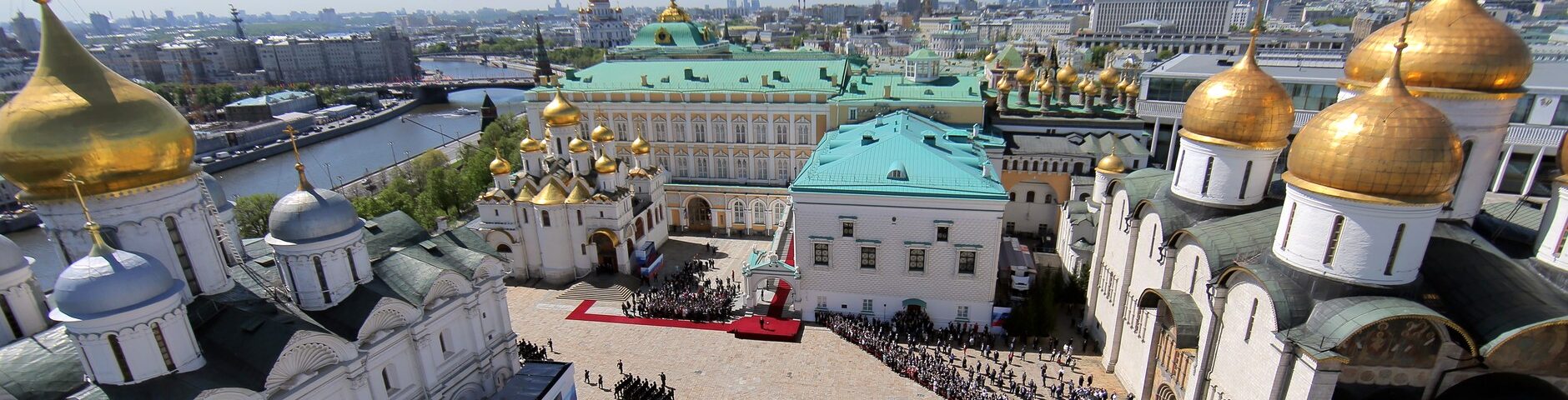
Image: Kremlin.ru