

A nation must think before it acts.
Publications
The Future of Iraq’s Minorities: What’s Next After ISIS
United States Senate Committee on Foreign Relations Watch the full testimony here....
Read more »Defining American Power & Liberal Order
Paul Miller has written a remarkable book on American grand strategy. In it, he defends the very concept of “grand strategy;” argues that contrary to the opinion of some commentators, the United States has pursued a largely consistent grand...
Read more »The Emergence of the Modern U.S. Army
This book by J.P. Clark, an active duty army officer who has previously served on the history faculty at West Point, examines how the U.S. Army prepared for war from 1815 to 1917. Clark focuses primarily on the intersection...
Read more »Traps or Gaps? Rising Powers and Declining Order
Last year, I lectured to a visiting class of new generals and admirals from the People’s Liberation Army (PLA) at the National Defense University in Washington. My briefing presented my research on why major conflict in the next ten...
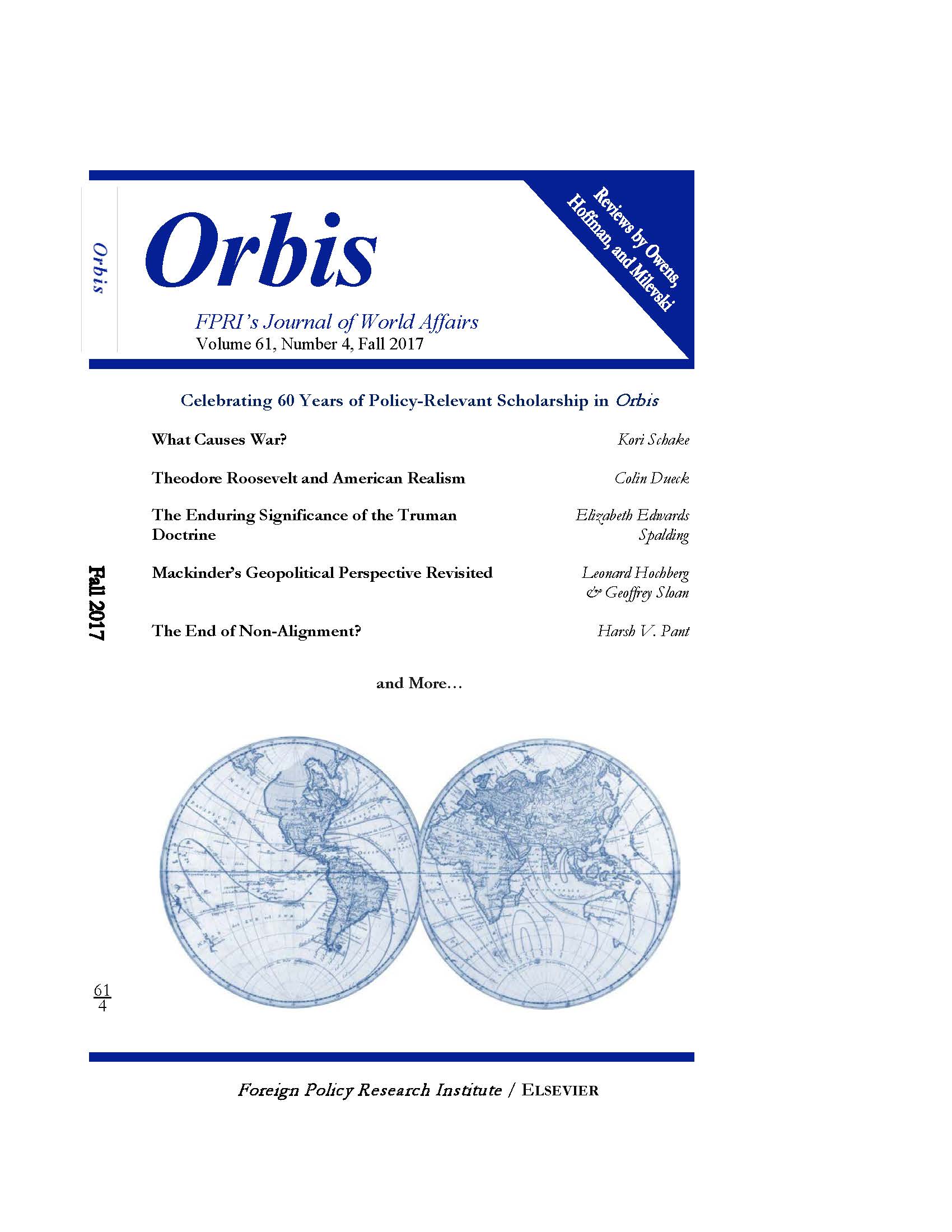
Read more »Mackinder’s Geopolitical Perspective Revisited
Abstract This article explores three themes related to classical geopolitics: first, it presents reasons why scholars and commentators abandoned geopolitical analysis after World War II, and then reengaged with geopolitical factors after the Soviet Union’s collapse; second, it suggests...
Read more »The Enduring Significance of the Truman Doctrine
Abstract The Truman Doctrine is seventy years old, which means it could easily be considered an artifact of history. In the age of Donald J. Trump, one might reasonably ask, what use is there for a doctrine that set...
Read more »Theodore Roosevelt and American Realism
Abstract Theodore Roosevelt’s foreign policy as president was animated by a desire to see the United States play a leading role in world affairs. He utilized skillful diplomacy, energetic executive action, and credible naval capabilities to support this forward...
Read more »The End of Non-Alignment?
Abstract The lack of interest in the Non-Aligned Movement (NAM) today is symptomatic of the larger demise of the non-alignment as a political ideology in global politics. And India’s case is the best exemplar of this global shift. India’s...
Read more »Principled Agents: The Role of Service Culture in American Civil-Military Relations
Abstract This article joins a robust literature in confronting an enduring dilemma of organized politics: who guards the guardians—and how? Building on an agency theory of civil-military relations, this article introduces a new way to think about the American...
Read more »The War and the West
Editor’s Note: We reprint this significant article from James Kurth about post-9/11 war, published in our Spring 2002 edition. He is the Claude Smith Professor Emeritus, Political Science, Swarthmore College, a Senior Fellow at the Foreign Policy Research Institute,...
Read more »